The parent books the party. The kid needs a reason to come back.
- Client
- Brickworks
- Industry
- Independent toy resale — two retail locations
- Engagement
- Client work
- Status
- Pre-launch
- Role
- Art Direction, UI Design, Interactive Build
- Stack
- Next.js, Tailwind CSS, Canvas game loop, Lenis, JSON-LD
Deployment note — Build is on a preview URL. The shop’s production domain currently still serves their previous Shopify store.
02
Problem
A physical retail business whose revenue comes from foot traffic and bookable birthday parties, not online orders. A conventional e-commerce build would have optimized the wrong thing entirely — and the person who decides whether the family visits is not the person holding the credit card.
03
Insight
There are two users and only one of them can be sold to. The parent needs hours, an address, and a booking form that confirms. The child needs a reason to ask to go back. So the site was built to serve both: a short, ruthlessly clear conversion path for the adult, and something genuinely fun for the kid sitting next to them.
04
Direction
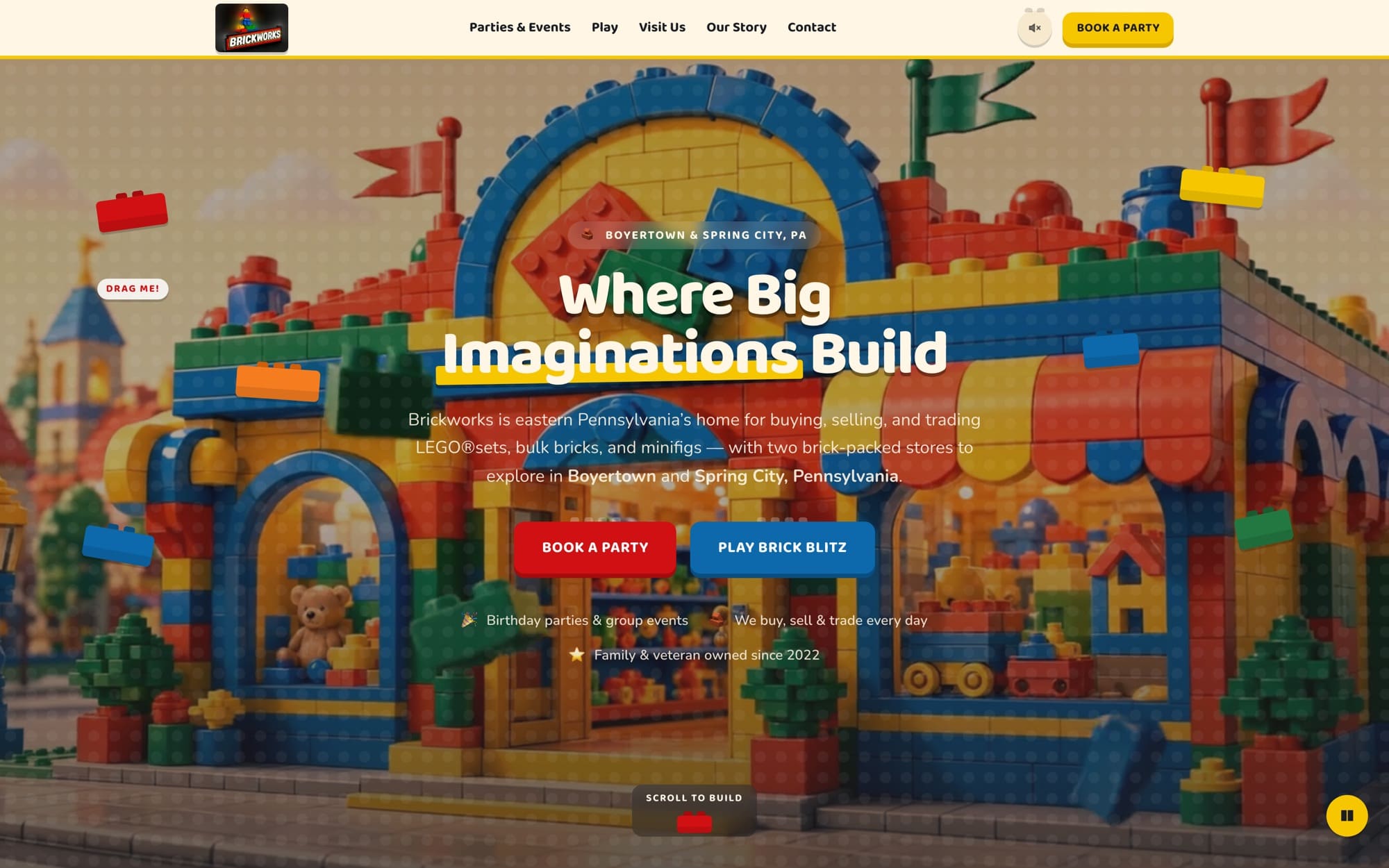
Brick primaries used honestly — red, blue, yellow, green, orange on cream and charcoal — with a rounded display face over a humanist sans. Loud, saturated and unembarrassed, because the alternative is a muted ‘tasteful’ palette that neither audience wants. Real in-store photography, swipeable on touch.
05
Execution
Seven routes, no more. Hero, a three-step explanation of how a trade works, a six-image in-store gallery, three party packages with prices and capacities stated up front, and a two-location block with hours and directions. Everything else was cut.
06
System
The game is a real build, not a widget: a falling-block stacker with score, level, and line tracking, a hold box, a next queue, full keyboard controls, and touch buttons for phones. Two ToyStore structured-data nodes — one per location — carry separate geo coordinates, and opening hours, so each shop is independently legible to local search.
Routes
7
Observed in build
Retail locations
2
Published by client
Playable game
Keyboard + touch controls
Observed in build
Family- and veteran-owned since 2022, party packages from $249, and a one-business-day booking confirmation. Those are the client’s published terms. No performance data exists for this build and none is claimed.
Reflection
The gap I would close first has nothing to do with design: the second location shows a city and a postcode but no street address, behind a ‘get directions’ link that has nothing to direct to. A retail site that cannot tell you where the shop is has failed at its only unavoidable job.