A trade site built like a specification, not a brochure.
- Client
- Armored Power Systems LLC
- Industry
- Licensed electrical contractor — standby power
- Engagement
- Client work
- Status
- Pre-launch
- Role
- Art Direction, Design System, Information Architecture, Copy
- Stack
- Next.js, Tailwind CSS, Static generation, JSON-LD
Deployment note — Build is on a preview URL. The client’s production domain currently still serves their previous Duda site. The preview hostname is also misspelled ‘amored’ — a deployment alias issue, not a design decision.
02
Problem
A licensed electrical contractor with no storefront, selling a five-figure purchase to people who have never bought one before. The category is dominated by national franchises with recognizable names and by contractors who win on price. Every lead arrives already suspicious, and the thing being sold — a generator that sits silently for a year and then has to work — cannot be demonstrated.
03
Insight
The buyer is not shopping for a generator. They are trying to work out who is lying. In a market where every competitor claims the same brands and the same warranty, the only durable advantage is being the source that answers the question the customer does not yet know how to ask. So the site was built to teach, not to pitch — including an explicit list of the eight questions to ask any installer, which a customer can carry to a competitor’s quote.
04
Direction
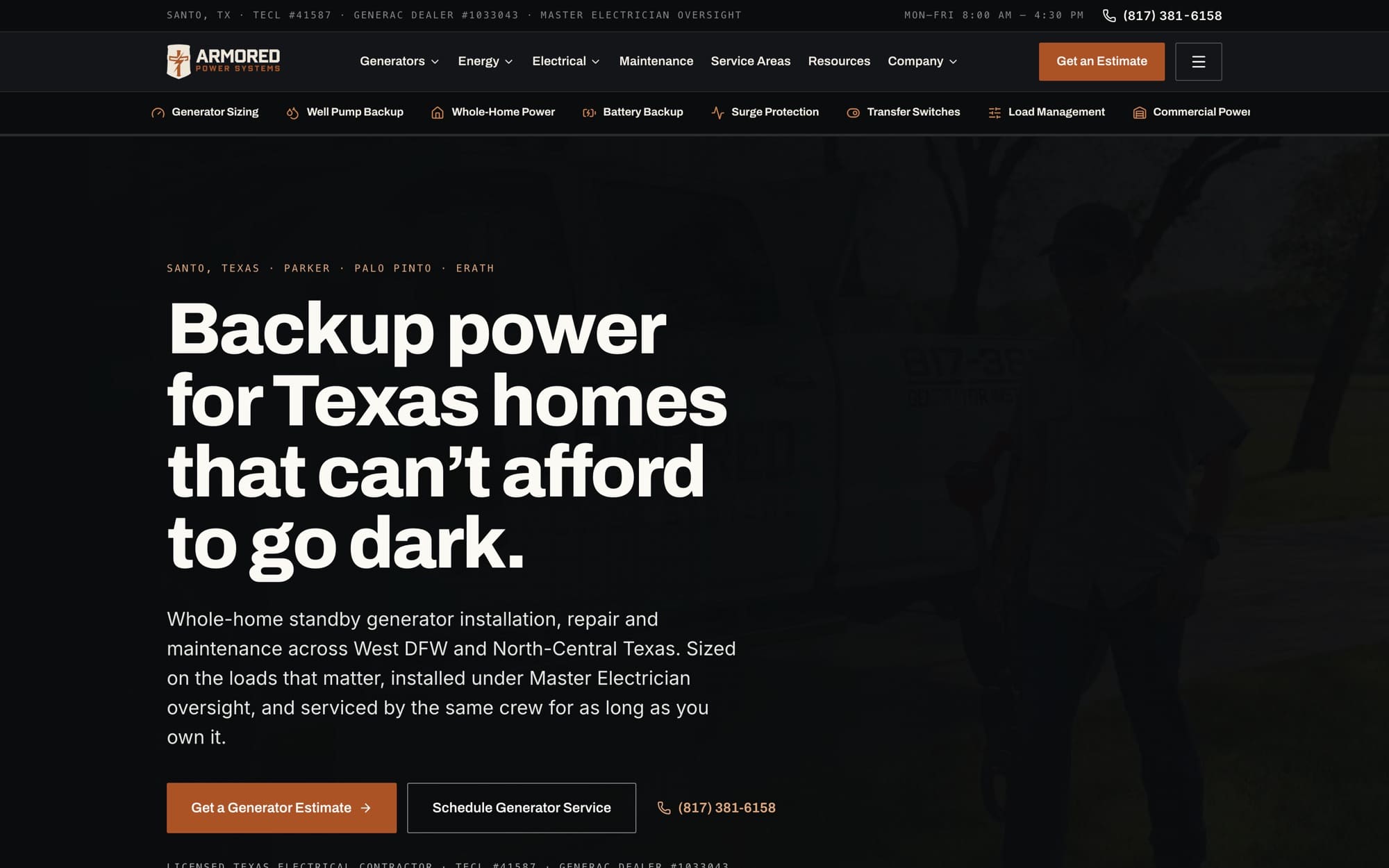
Industrial-utilitarian rather than the blue-and-yellow contractor default. A four-token palette — near-black, warm off-white, copper, moss — with numbered section ordinals and long-form prose blocks where the category expects icon cards. Real field photography of the crew and the equipment, captioned like equipment documentation: pad, conduit, and transfer switch.
05
Execution
Fifty-eight routes across three service pillars, fifteen service-area pages covering twelve municipalities and three counties, and ten long-form resource articles. Credentials — Texas Electrical Contractor license and Generac dealer number — sit in the masthead on every page rather than buried on an About page. Maintenance plans are presented as three named recurring tiers, because recurring revenue is the actual business model underneath the installs.
06
System
Statically generated throughout. A single JSON-LD graph carries Electrician, Organization, Person, FAQPage, four AdministrativeArea nodes, geo coordinates, and opening hours, so the service-area pages are legible to search engines as one business operating across a region rather than fifteen unrelated pages. No animation library — the site is deliberately static, because a contractor’s site loading fast on a phone in a field matters more than motion.
Routes
58
Observed in build
Service-area pages
15
Observed in build
Resource articles
10
Observed in build
TECL license
#41587
Published by client
The reviews page is the decision I would defend hardest. It embeds the third-party review feed and states plainly that nothing on the page is retyped, edited, or curated. In a category built on inflated testimonials, refusing to touch the reviews is the strongest available proof.
Reflection
The temptation on trade sites is to compress everything into scannable cards. This one goes the other way and asks the reader to actually read. That only works because the underlying expertise is real — the copy could be written at that depth because the operator could answer at that depth. Design cannot manufacture that.