Leaving the platform without leaving the rankings.
- Client
- 1689 Armory
- Industry
- Direct-to-consumer protective equipment
- Engagement
- Client work
- Status
- Live
- Role
- Art Direction, UI Design, Design System
- Stack
- Next.js, Custom commerce, Authentication, Admin surface, llms.txt
02
Problem
A body-armour retailer on hosted e-commerce, in a category that payment processors and platforms restrict or remove without much notice. Every transaction carried a platform fee, and the entire storefront sat on infrastructure the business did not control and could lose. Migrating off it normally means surrendering years of accumulated search equity.
03
Insight
The migration risk is not the storefront, it is the URLs. Rebuild the commerce layer however you like, but if the collection and product paths change, the business pays for its independence in lost rankings. So the new application preserves the old platform’s URL structure exactly — the addresses survive, the infrastructure underneath them does not.
04
Direction
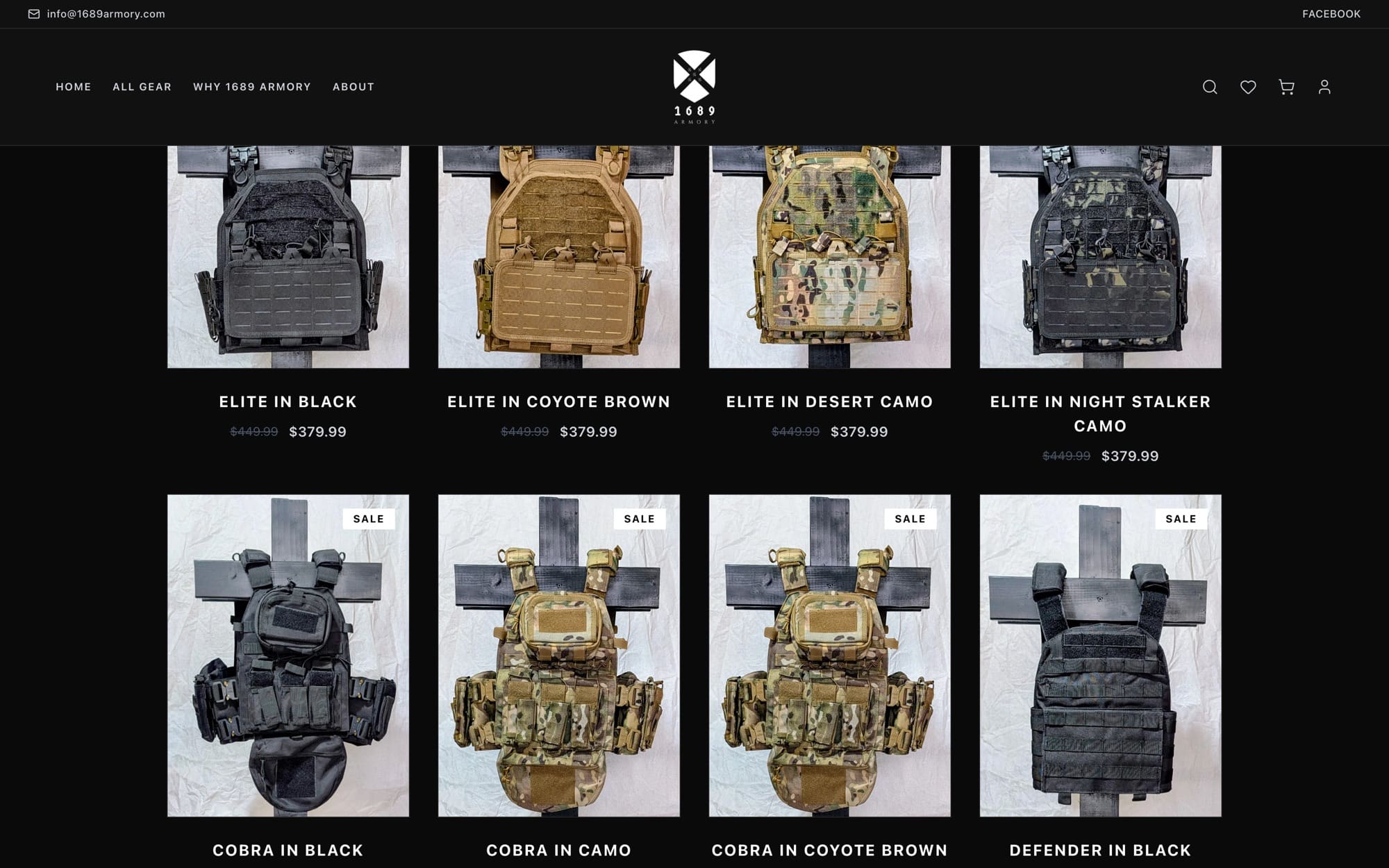
The site should look like the product it sells. Black grounds, coyote and camo accents, heavy sans headers over full-bleed product and field photography. Products are shot flat and consistent against a plain ground so the grid reads as a rack rather than a carousel. Restraint in a category that usually shouts.
05
Execution
A custom commerce application: catalog and collections, cart, customer accounts and authentication, a wishlist, checkout, and an authenticated admin surface. No hosted-commerce scripts remain in the markup — the entire transaction path is owned.
06
System
The build also ships an llms.txt and an explicit AI-crawler allowlist in robots.txt covering the major answer engines. That is a deliberate bet that a meaningful share of future product discovery happens inside an assistant’s answer rather than a results page, and that a restricted category should be legible to those systems on its own terms.
Commerce surfaces
Cart, accounts, wishlist, checkout, admin
Observed in build
Hosted-platform scripts
None remaining
Observed in build
Legacy URL paths
Preserved
Observed in build
No performance figures are published for this build and none are claimed here. What is verifiable is structural: a hosted storefront replaced by an owned application, with the URL structure and the customer-facing paths intact.
Reflection
If I were advising this client on the next increment, it would not be design. It would be publishing the plate certification and test documentation. For a product where failure is measured in lives, an uncertified ‘exceeds military-grade’ claim is simultaneously the biggest liability and the biggest conversion leak on the site. No amount of art direction fixes that.