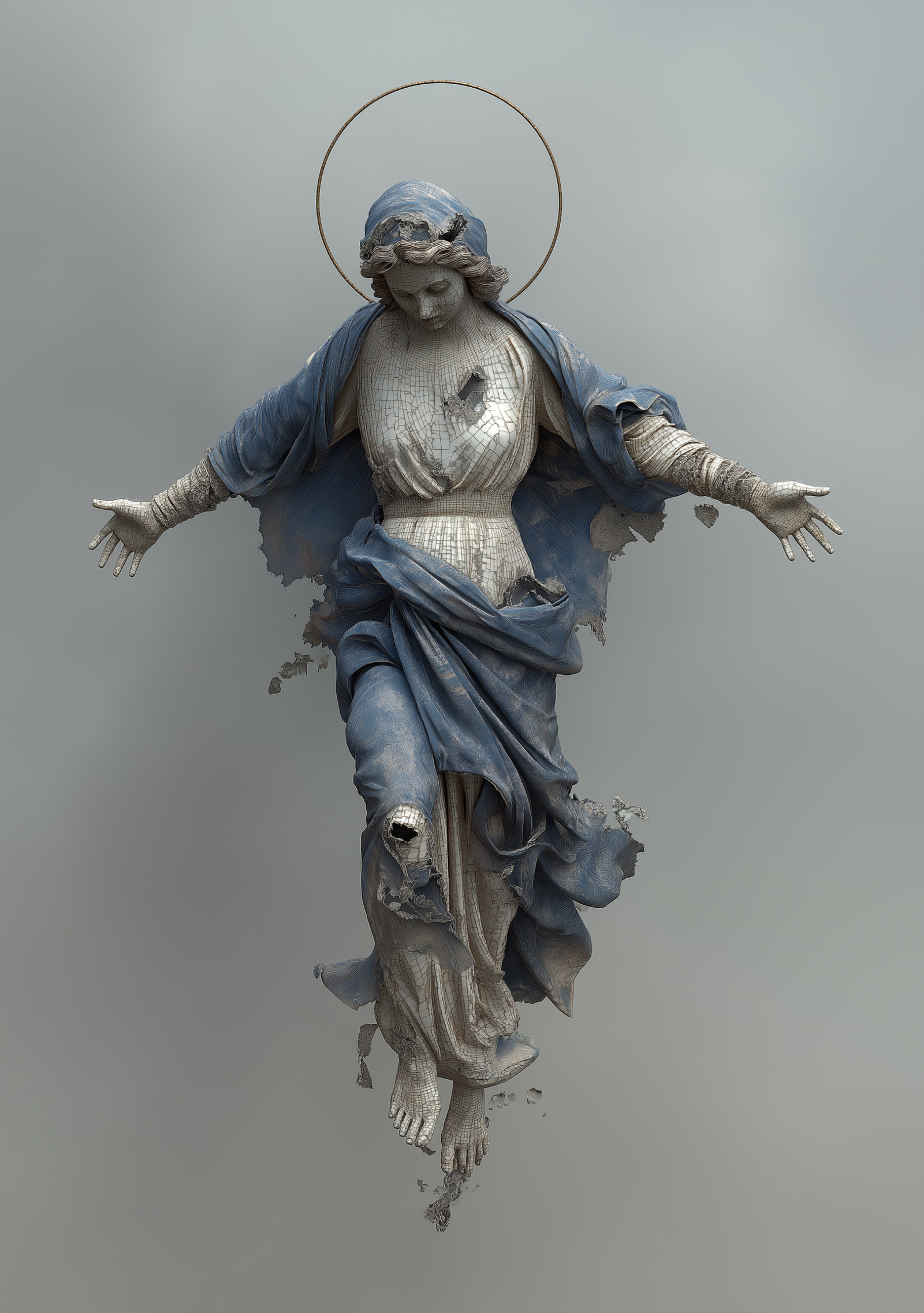
I. Introduction: From Mother of Jesus to Queen of Heaven—How Did We Get Here?
Let’s get one thing straight right off the bat: Mary was blessed. No true follower of Christ denies that. She was handpicked to carry the Savior of the world in her womb. That’s not small potatoes. That’s huge. That’s sacred. That’s honor.
But honor is one thing. Idolatry is another.
Now, somewhere along the ecclesiastical timeline—between the early church’s respect for Mary and the gold-plated statues of her being crowned by cherubs—the Roman Catholic Church took a hard left turn into theological absurdity. They didn’t just honor Mary. They escalated her into something far beyond what Scripture ever teaches—a sort of semi-divine figure who floats somewhere between Jesus and the Holy Spirit in the pecking order of Heaven.
We’re talking about a system that teaches:
- Mary stayed a virgin forever (despite raising a whole household of kids),
- She was conceived without sin (despite admitting she needed a Savior),
- She was bodily assumed into Heaven (despite there being zero scriptural or early historical evidence), and
- She’s now your co-mediator, co-redeemer, and spiritual hotline to Jesus (despite 1 Timothy 2:5 punching that concept right in the mouth).
What started as reverence has morphed into full-blown spiritual fan fiction—a fantastical theology of “Queen of Heaven” crowned with stars and worshipped in shrines… by people who claim they’re not worshipping her. (Spoiler: if you pray to someone, build them altars, and sing hymns to them, that’s not a birthday party. That’s worship.)
But here’s the deal: this blog isn’t a hit piece on Catholic people. Most of them are sincere, kind-hearted, and devoutly committed to what they’ve been taught. This is a wake-up call against the institutional traditions that have buried the Bible under centuries of incense and Latin.
We’re going to walk through all four major Marian dogmas:
- Perpetual Virginity
- Immaculate Conception
- Bodily Assumption
- Mary as Co-Redemptrix / Mediatrix
And we’re going to bring Scripture, Church history, and serious theological thinking to the table—not tradition, not papal declarations, and not sentimentalism dressed in piety.
This isn’t “anti-Catholic.” This is pro-Bible.
This isn’t icon-smashing for the fun of it. This is truth-telling for the good of the Church.
This isn’t Reformed theology for theology’s sake. It’s Scriptural Christianity—the kind that holds every doctrine up to the Word of God and says, “Show me the verse.”
So if you’re ready to burn some golden calves and dust off your Bible, let’s get to it.
II. Perpetual Virginity: Because Apparently God Couldn’t Use a Womb More Than Once?
Ah yes, the Roman Catholic claim that Mary remained a virgin before, during, and after the birth of Christ. Because apparently, the womb that carried the Savior needed to be forever sealed off like Area 51.
This idea didn’t come from the Gospels. It didn’t come from the apostles. It didn’t even come from Mary herself. It came from tradition—a medieval cocktail of Gnostic disdain for the body and pagan elevation of virginal purity. Somewhere along the line, Rome decided that marital intimacy is somehow dirty—even between a godly husband and wife like Mary and Joseph.
Let’s ask the one question Catholics don’t seem too keen to ask:
What does the Bible actually say?
Matthew 1:24–25 — The Greek Wrecking Ball
“When Joseph woke from sleep, he did as the angel of the Lord commanded him: he took his wife, but knew her not until she had given birth to a son. And he called his name Jesus.” (Matt. 1:24–25, ESV)
Let’s talk about that pesky little word—“until.”
In Greek, it’s heōs hou (ἕως οὗ). This isn’t some vague poetic flourish. It’s a time marker that means “up to a certain point, but not after.”
Imagine if I said, “I didn’t eat tacos until after church.” Nobody in their right mind would assume I swore off tacos forever. You’d assume the tacos flowed freely after the benediction.
The same principle applies here. Matthew is saying Joseph refrained from sexual union with Mary until Jesus was born. That doesn’t mean he lived in a monastic vow of celibacy for the rest of his life. It means once the Messiah was born, their marriage resumed as normal.
Even the Catholic theologian Raymond Brown—hardly a Protestant cheerleader—admits that heōs hou “suggests a change after the period indicated” (Anchor Bible Commentary, The Birth of the Messiah).
Oops.
Luke 2:7 — Firstborn ≠ Only Child
“And she gave birth to her firstborn son…” (Luke 2:7)
Key word: firstborn. Not only child. Not miracle singleton.
The Greek (prōtotokos) implies there were more to come.
If Mary had only one child, Luke could’ve used monogenēs—like John does to describe Jesus as the only-begotten Son of God (John 3:16). But he didn’t. He used firstborn, implying a sequence.
The term firstborn in Jewish culture was a legal designation that assumed siblings. You didn’t have a “firstborn” unless a “second-born” was on the horizon.
Mark 6:3 — Meet the Family
“Is not this the carpenter, the son of Mary and brother of James and Joses and Judas and Simon? And are not his sisters here with us?” (Mark 6:3)
So… Jesus had brothers? And sisters?
Yep. The townspeople of Nazareth knew His family by name.
Now cue the Catholic tap dance.
Objection: “Those were cousins, not actual siblings!”
Response: False. The Greek word for “brothers” is adelphoi—used consistently in the New Testament for actual, biological siblings.
When the New Testament wants to say “cousin,” it uses anepsios. (See Colossians 4:10—“Mark the cousin of Barnabas”). The Gospel writers didn’t say that. They said “brothers.” They meant what they said.
Objection: “Maybe Joseph had children from a previous marriage.”
Response: Oh good, now we’re adding a whole missing family tree just to protect a doctrine that Scripture doesn’t teach. Theological fan fiction strikes again.
Matthew 12:46–50 — Jesus Had Siblings Who Showed Up
“While he was still speaking to the people, behold, his mother and his brothers stood outside…” (Matt. 12:46)
Were His cousins and step-siblings just out running errands together that day? Or does it make more sense that Mary had other children and they were checking in on their now-famous older brother?
In fact, John 7:5 tells us that “even His brothers did not believe in Him.” That tracks with actual siblings. Not metaphorical cousins raised on Roman assumptions.
Joseph: The Most Underrated Saint in the Bible
Let’s pause to appreciate how utterly disrespected Joseph gets in this dogma. According to Rome, Joseph was married to a woman he never touched. He protected her. Provided for her. Raised a son that wasn’t biologically his. And then… just lived in chaste abstinence?
That’s not biblical manhood. That’s monkhood. And Joseph wasn’t a monk. He was a husband.
Paul says in 1 Corinthians 7:3–5 that marital intimacy is part of a godly union—not something shameful to be avoided. The Roman idea that Joseph would reject this gift from God to protect Mary’s womb like a sacred relic is both unbiblical and dishonoring to God’s design for marriage.
The Real Problem: Purity Culture on Papal Steroids
Let’s be honest. The perpetual virginity dogma doesn’t come from Scripture. It comes from Gnostic pollution that crept into the early church—an idea that spiritual = good, physical = bad.
But Christianity has never taught that. God made marriage. God made intimacy. God made babies. And He called it all very good (Genesis 1:31).
By insisting Mary never had sex—even in marriage—Rome exalts virginity to the point of absurdity, as if being a wife and mother is somehow beneath the “Queen of Heaven.” They treat Mary’s womb like a museum exhibit: “Look, but don’t touch.”
But Scripture treats Mary like a faithful woman who obeyed God, loved her husband, and raised a family—including the sinless Savior and some very normal, very sinful siblings.
Drop the Halo, Keep the Honor
Mary was blessed, not untouchable.
She was favored, not forever untouched.
She had faith, not a platinum chastity belt.
Rome’s claim that Mary remained a virgin forever isn’t just unsupported by Scripture—it’s flat-out contradicted by it. The Gospels name her children. The Greek grammar gives it away. The historical context makes it clear.
The doctrine of perpetual virginity is what happens when you replace the Word of God with the whispers of tradition. And Scripture isn’t interested in preserving your shrine—it’s interested in telling the truth.
Next time someone tells you Mary was “ever virgin,” you have biblical permission to smile politely, open your Bible, and say: “Let’s read what it actually says.”
III. The Immaculate Conception: Mary Without Sin? Show Me the Verse.
Time to clarify the confusion: The Immaculate Conception is NOT about Jesus’s virgin birth (which is biblical). It’s Rome’s claim that Mary herself was conceived without sin—that she was preserved by divine grace from the stain of original sin from the very moment of her own conception.
And if your immediate reaction is, “Wait… what?”, you’re not alone. Because Scripture never even hints at this. You won’t find it in Matthew, Mark, Luke, John, Paul, Peter, or any writer inspired by the Holy Spirit.
This dogma is pure theological invention, declared ex cathedra by Pope Pius IX in 1854 (yes, eighteen hundred years after Christ walked the earth). According to the Vatican’s own Catechism (CCC §491), Mary was “redeemed… in the instant of her conception… preserved immune from all stain of original sin.”
So let’s ask the question Rome doesn’t want to hear:
Where’s the biblical proof?
Spoiler alert: there isn’t any. But don’t worry—they brought incense and Latin, so it must be legit.
Luke 1:46–47 — Mary’s Mic Drop Confession
Let’s begin where Rome refuses to start: with Mary’s own words.
“My soul magnifies the Lord, and my spirit rejoices in God my Savior.” (Luke 1:46–47, ESV)
Did you catch that? Mary just called God her Savior.
Let’s do some theological math:
- If Mary was conceived without sin,
- Then Mary didn’t need saving from sin,
- Which makes her confession… awkward.
But she wasn’t awkward. She was honest. She was faithful. And she was humble enough to confess her need for a Savior, just like the rest of us.
Now, Rome tries to squirm out of this by saying something like, “Well, God saved her preemptively by applying Jesus’s future work retroactively.”
Cool story. But again:
Show me the verse.
Seriously. If you have to build your doctrine on hypothetical time-traveling grace mechanisms never mentioned in Scripture, you’ve already lost.
Romans 3:23 — All Means All
“For all have sinned and fall short of the glory of God.” (Romans 3:23)
Paul didn’t say “all… except this teenage girl from Nazareth.”
He said all. The Greek word for “all” is pantes—and it means… brace yourself… all.
The only human in all of redemptive history who was without sin was Jesus Christ (Hebrews 4:15). He is the second Adam (Romans 5:12–19), the only one who succeeded where the first failed. There is no biblical case for a sinless “second Eve.” None. Zip. Zero.
Even Augustine, the theological heavyweight so often claimed by Rome, explicitly said in Homilies on the Gospel of John (41.8):
“Mary, though a virgin, conceived in iniquity, and in sin did her mother conceive her.”
Sorry, Rome. You can’t cherry-pick Augustine and then ignore him when he calls out your myth.
Let’s Talk About the Real Roots of This Doctrine: Paganism and Purity Obsession
Here’s what’s really going on: The Immaculate Conception was Rome’s attempt to prop up a Mary-centered redemption narrative to justify the other heresies they built around her.
They say, “Jesus is too holy to be born from someone sinful.”
Okay, then what about the rest of His genealogy? Rahab the prostitute? Bathsheba the adulteress? Tamar, who seduced her father-in-law? Read Matthew 1 sometime—it’s not exactly squeaky clean.
But that’s the point: God brings the Holy from the unholy. That’s the whole point of grace. That’s the whole point of the gospel. Jesus wasn’t born of a sinless woman—He was born of a sinless God through a faithful, sinful servant.
Rome’s doctrine implies that Jesus needs help being holy—as if sin could be transferred through DNA. News flash: that’s heresy. Jesus’s sinlessness isn’t because Mary was pure. It’s because Jesus is God.
Early Church Testimony? Rome’s Not As Unified As They Pretend
Now Catholics love to claim unanimous early Church support for Marian dogmas. Let’s bust that bubble:
- Origen (3rd century): “Mary, like all human beings, was in need of salvation.”
- John Chrysostom (4th century): Criticized Mary’s behavior in Mark 3:21 when she tried to restrain Jesus, saying she showed “lack of faith.”
- Cyril of Alexandria (5th century): Praised Mary’s faith but never once claimed she was sinless.
- Irenaeus (2nd century): Elevated Mary’s role typologically but made no claim of her sinlessness.
Not one of these men preached what Rome would later demand as dogma. If the Immaculate Conception was “always believed everywhere by all,” the early Church forgot to mention it.
Even Thomas Aquinas—Rome’s own theological poster boy—rejected the Immaculate Conception. He wrote in Summa Theologiae (Part III, Q27):
“The Blessed Virgin did indeed contract original sin, but was cleansed therefrom before her birth from the womb.”
That’s right—Aquinas disagreed with the dogma Rome now says you must believe to be saved. You can’t make this stuff up.
What’s at Stake: Undermining Christ to Elevate Mary
Let’s stop pretending this is a harmless bit of theological fluff. It’s not.
The Immaculate Conception doctrine:
- Distorts original sin, by suggesting someone could bypass it without Christ’s direct redemptive act.
- Minimizes the uniqueness of Christ, who alone was born sinless by nature, not by exemption.
- Injects confusion into the gospel, replacing salvation with sentimentalism and Maryolatry.
When you say Mary was sinless, you say Jesus didn’t need to be her Savior.
When you say Mary was preserved from sin, you suggest there’s another path to holiness besides regeneration.
That’s not just a theological misstep. That’s an existential threat to the gospel.
God Doesn’t Need a Sinless Vessel—He Needs a Willing One
Mary was extraordinary—not because of some supernatural immunity to sin, but because she believed God, obeyed Him, and trusted in the same Savior we do.
She needed grace. She admitted it.
She needed a Savior. She rejoiced in Him.
She wasn’t holy by nature—she was made holy by faith.
The Immaculate Conception is an invented doctrine designed to exalt Mary to godlike status. It doesn’t elevate Scripture—it contradicts it. It doesn’t clarify grace—it corrupts it.
If you want to honor Mary, do what she did:
Magnify the Lord—not yourself, not tradition, and certainly not Rome.
IV. The Bodily Assumption: Like Enoch and Elijah… Except Zero Scriptural Evidence
So let me get this straight—Mary didn’t die like the rest of us common mortals. Nope. According to Rome, she was bodily assumed into Heaven, glorified and exalted, because… well… because they said so.
This isn’t folklore. It’s official Catholic dogma, defined infallibly by Pope Pius XII in 1950 (yep, 1950, not a typo). His Munificentissimus Deus declared that “the Immaculate Mother of God… was assumed body and soul into heavenly glory.”
You know what’s missing from that decree? Any verse—just one—that says this actually happened.
Let’s Play a Game: Find the Assumption in Your Bible
Spoiler: you won’t. Because it’s not there.
- Matthew? Nope.
- Luke? Nada.
- Acts? Silent.
- Revelation? Sorry, that woman clothed with the sun (Rev. 12:1) is Israel, not Mary.
- Paul? Never even hints at it.
If this was such a monumental event—God snatching a glorified Mary body-and-soul into heaven—you’d think somebody would’ve mentioned it. A footnote? A passing comment? Something?
But the apostles? Crickets.
The early church? Silent for centuries.
The first real whisper of this idea doesn’t show up until the late 4th century, and even then, it’s more theological fanfiction than apostolic tradition.
But What About Enoch and Elijah?
Rome loves to say, “Well, God did it for Enoch (Genesis 5:24) and Elijah (2 Kings 2:11). So why not Mary?”
Two problems:
- Scripture records those assumptions explicitly. It says Enoch “walked with God, and he was not, for God took him.” It says Elijah went up in a chariot of fire.
- Mary’s assumption has zero documentation. If we accept this logic, we might as well assume Jeremiah rode a unicorn to heaven.
Let’s not build dogma on what-ifs and “God could’ve.” That’s how cults get started.
Early Church? Not United, Not Dogmatic, Not Inspired
Catholics love to say, “The early church believed this!” Again, let’s bring facts to the party.
- The earliest mention of anything resembling an assumption is from pseudo-Epiphanius (late 4th century), who speculated on the topic but didn’t claim certainty.
- Writings like the Transitus Mariae (5th–6th century) speak of Mary’s assumption, but they’re apocryphal, contradictory, and not Scripture.
- The Eastern Orthodox church celebrates the Dormition of Mary—her death—but even they don’t dogmatize the bodily assumption.
In fact, as late as the 13th century, theologians were still debating whether Mary died or not, much less floated skyward. So when Pius XII declared this dogma “infallible,” he wasn’t affirming ancient truth. He was making up for nineteen centuries of silence with one big papal megaphone.
Thomas Aquinas? Nope. Augustine? Silent. Scripture? Laughably absent.
That’s right—Rome’s most celebrated theologians didn’t teach it.
- Aquinas said nothing about an assumption.
- Augustine never mentions it.
- Jerome? Zilch.
- Calvin? Crushed the idea as superstition.
- Luther? Honored Mary but didn’t touch the assumption with a ten-foot censer.
The Reformation—and more importantly, Scriptural Christianity—consistently refused to accept this as doctrine because God’s Word never teaches it.
Let’s Be Honest: This Was Rome Covering Its Doctrinal Tracks
Here’s the dirty little secret: the Bodily Assumption wasn’t about Mary.
It was about shoring up the Immaculate Conception.
If Mary was truly sinless, then she couldn’t have suffered the corruption of death (Romans 6:23). So, to protect their invented doctrine, Rome had to make up another one to keep the logic duct-taped together.
But Romans 5:12 says plainly:
“Therefore, just as sin came into the world through one man, and death through sin, and so death spread to all men because all sinned…”
Mary died—because she was a sinner, like every other human besides Christ. Her body, like ours, awaited the resurrection (1 Thessalonians 4:16–17). She’ll rise again with the saints, not ahead of them because of doctrinal favoritism.
What’s Really at Stake: The Eclipse of Christ’s Glory
Let me put it plainly:
This dogma doesn’t elevate Mary. It competes with Christ.
Christ is the firstfruits of the resurrection (1 Cor. 15:20).
Christ is the only one glorified ahead of His people.
Christ is the ascended and reigning King—not co-reigning with His mom.
When Rome declares Mary was assumed into heaven, glorified body and soul, crowned Queen of Heaven… they’re not celebrating Scripture. They’re crafting a rival narrative.
The glorification of Mary detracts from the exclusive, exalted, cosmic supremacy of Jesus Christ.
It’s bad theology. It’s worse Christology.
And it’s absolutely foreign to the inspired Word of God.
No Bones, No Bible, No Basis
Rome likes to say, “Well, we don’t have Mary’s bones—so she must’ve been assumed!”
By that logic, Enoch, Melchizedek, and half the Old Testament prophets were also assumed. Maybe Jonah flew into heaven riding a whale. Absence of evidence is not evidence of bodily glorification.
Here’s what we do know:
- Scripture says nothing of Mary’s assumption.
- The apostles say nothing of Mary’s exaltation.
- The gospel gives us one resurrected, ascended, glorified mediator—Jesus Christ.
Mary is with the saints. But she’s not wearing a crown.
She’s waiting for the resurrection just like the rest of us—resting in the Savior she magnified, not glorified in her own right.
So next time someone mentions the Assumption, you have every right to ask:
“Where’s the verse?”
And when they can’t give you one, just smile and say, “Yeah… that’s what I thought.”
V. Mary as Co-Redemptrix and Mediatrix — That’s Not Honor, That’s Heresy
You’d think after inventing doctrines about Mary’s womb, her sinlessness, and her bodily assumption, Rome would hit the brakes. But no—somewhere along the theological autobahn, they floored it straight into blasphemy, declaring that Mary not only cooperated in Christ’s redemption but that she now intercedes and mediates on your behalf… as if Jesus needs a secretary.
The Catechism of the Catholic Church (CCC §969) claims:
“Taken up to heaven she did not lay aside this saving office… Therefore the Blessed Virgin is invoked in the Church under the titles of Advocate, Helper, Benefactress, and Mediatrix.”
And elsewhere, she’s described as “Co-Redemptrix.”
Not “witness,” not “servant,” but co-redeemer. As in, with Jesus. You know, the One the Bible says did it alone?
This isn’t pious poetry. It’s damnable doctrine.
1 Timothy 2:5 — Scripture Mic Drop
Let’s start with the theological nuke:
“For there is one God, and there is one mediator between God and men, the man Christ Jesus.” (1 Timothy 2:5, ESV)
Let me repeat that for the people in the back:
ONE mediator.
Not two. Not one and a half. Not “Jesus… and His mom.”
Paul didn’t forget Mary. He just knew she didn’t belong in the equation.
Mary as “Mediatrix”? Rome, Meet Hebrews
The entire book of Hebrews exists to exalt Christ’s priestly, mediating work. He is our Great High Priest (Hebrews 4:14), our intercessor (Hebrews 7:25), the one who entered once for all into the holy places (Hebrews 9:12).
If Mary is truly a mediatrix—participating in or continuing Christ’s mediating role—then Hebrews is lying. Or at the very least, it’s severely underinformed.
And I’ll take Holy Spirit inspiration over Vatican speculation every time.
Rome’s Argument: “But She Participated in Redemption!”
Yes. So did the donkey that carried Jesus into Jerusalem.
Shall we ordain it “Co-Redeemer of Salvation Week”?
Here’s how the logic breaks down:
- Mary said “yes” to God (Luke 1:38).
- She stood at the foot of the cross (John 19:25).
- She suffered emotionally as Jesus died.
Therefore… she co-redeemed the world?
That’s not theology. That’s emotional manipulation masquerading as doctrine.
Using Mary’s presence to justify her participation in redemption is like saying a mother watching her child enlist in the military deserves a Purple Heart. Noble? Yes. Saving? No.
Only Christ bore our sins (1 Peter 2:24).
Only Christ was pierced for our transgressions (Isaiah 53:5).
Only Christ shed redeeming blood (Hebrews 9:22).
And last I checked, Mary wasn’t crucified for your sins.
Rome’s Soft-Pedaling: “Well, She Only Mediates Through Christ…”
Ah, the classic dodge.
Rome says Mary is a “subordinate” mediator—only ever interceding through Christ. Kind of like Jesus’ assistant manager. She doesn’t save you—she just helps Him do it better.
But again:
If Jesus needs help mediating, He’s not a perfect mediator.
And if He’s not perfect, He’s not God.
Let’s be blunt: the very notion of any other mediator—even a subordinate one—is a direct assault on Christ’s sufficiency. If Jesus isn’t enough, then the gospel isn’t enough. And if the gospel isn’t enough, no one is saved.
Spiritual Bypass Surgery: Prayers “Through Mary”
Let’s talk about the most common real-world application of this heresy:
Praying to Mary.
Catholics will say they’re not worshiping her. “We’re just asking her to pray for us.”
Cool. But let me ask you:
- Do you kneel?
- Do you light candles?
- Do you sing hymns to her?
- Do you ask her for mercy, guidance, protection?
Because that’s not how you treat a prayer partner. That’s how you treat a deity.
And let’s not forget: in Acts 10:25–26, when Cornelius bowed to Peter, Peter yanked him to his feet and said, “Stand up; I too am a man.”
Meanwhile, Mary’s statues still get carried around town on golden platforms.
Jeremiah 7:18 — Queen of Heaven? Been There, Condemned That
“The children gather wood, the fathers kindle fire, and the women knead dough, to make cakes for the queen of heaven. And they pour out drink offerings to other gods, to provoke me to anger.” (Jeremiah 7:18)
It’s fascinating—Rome literally refers to Mary as the Queen of Heaven.
Problem: God already addressed that title.
In Jeremiah, it was a pagan abomination—part of idol worship that provoked the Lord’s wrath.
Repackaging Babylonian goddess titles for Mary doesn’t sanctify the practice. It just puts a halo on a golden calf.
Real Church History: When Mary Pointed to Jesus, Not Herself
The earliest believers didn’t pray to Mary. They didn’t sing to her. They didn’t declare her Co-Redemptrix or Heavenly Empress.
They imitated her faith, not her fictional status.
In the Gospels, Mary never seeks attention. She never points to herself. Her most iconic quote?
“Do whatever He tells you.” (John 2:5)
That’s the voice of a disciple, not a goddess.
That’s the humility of someone who knows she needs grace—not someone dishing it out from Heaven like a glorified barista of blessings.
The Real Danger: A Competing Gospel
Here’s the bottom line:
The Marian mediatrix/co-redemptrix doctrine is not just unbiblical. It is anti-biblical.
It:
- Adds to the finished work of Christ (John 19:30).
- Divides glory that belongs to Christ alone (Col. 1:18).
- Teaches a second source of grace, access, and mercy, when Hebrews 4:16 tells us to come boldly to the throne of grace because of Jesus, not His mother.
It is a competing gospel—and Paul had a few strong words about those.
“But even if we or an angel from heaven should preach to you a gospel contrary to the one we preached to you, let him be accursed.” (Galatians 1:8)
That’s not snark. That’s Scripture.
Mary Is Not Your Mediator—Jesus Is
Honor Mary? Absolutely.
Imitate her humility? Without question.
Turn her into a co-redeemer?
You’ve crossed the line from reverence into rebellion.
Mary’s glory is that she trusted her Son, not that she shares His throne.
She was redeemed—not redeeming.
She is saved—not saving.
She is blessed among women—not exalted above them.
So stop asking Mary for help. She’s pointing you to Jesus.
And if your doctrine doesn’t, then you’re not honoring her—you’re silencing her.
VI. Drop the Rosary and Pick Up the Bible — Why Marian Dogmas Matter
Let’s not sugarcoat it: The Marian dogmas are not harmless extras. They’re not “just little traditions” Rome tacked on for sentimentality. No, these are foundational pillars of a counterfeit gospel—a carefully crafted system that takes the focus off Christ and reassigns glory, honor, intercession, and even redemption to someone who was never meant to carry it.
This isn’t a theological footnote. It’s a five-alarm spiritual emergency.
Let’s Recap the Four Dogmas You Won’t Find in Your Bible:
- Perpetual Virginity – Already debunked. Mary had a normal, godly marriage, a household full of kids, and didn’t take a lifelong vow of celibacy like a medieval nun.
- Immaculate Conception – Declared sinless without a shred of scriptural support. God doesn’t “pre-save” people in secret. He saves openly, by grace through faith.
- Bodily Assumption – Invented 1,950 years after the Resurrection. Not one verse. Not one apostle. Not one credible historical witness.
- Mediatrix/Co-Redemptrix – Blasphemous. Flat-out contradicts the Gospel. Makes Mary a junior messiah instead of a humble servant.
Every one of these doctrines chips away at the absolute sufficiency of Christ.
- Christ alone is sinless (Hebrews 4:15).
- Christ alone redeems (1 Peter 1:18–19).
- Christ alone mediates (1 Timothy 2:5).
- Christ alone reigns (Philippians 2:9–11).
Not Christ and Mary.
Not Christ and the saints.
Not Christ and tradition.
Just Christ.
Dear Catholic Reader: You’ve Been Lied To.
I know that’s a gut punch. I know it hurts.
But truth often does.
You’ve been told that Mary’s intercession is necessary.
You’ve been told to trust the magisterium’s authority over Scripture.
You’ve been told that the grace of God must be funneled through candles, beads, and a woman who herself needed saving.
And all the while, Christ has been patiently waiting—sufficient, supreme, and sidelined by centuries of superstition.
Friend, that’s not devotion. That’s idolatry.
It doesn’t matter how emotionally satisfying the imagery is.
It doesn’t matter how many popes wear it as a badge of honor.
If the doctrine contradicts God’s Word, it’s not holy—it’s heresy.
Jesus Doesn’t Need Help. He Already Finished the Job.
“It is finished.” (John 19:30)
Those were Jesus’s final words on the cross—not “Tag in my mom for the rest.”
Christ didn’t lay down His life just to be co-savior with Mary.
He didn’t tear the veil in two just so you could pray through her instead.
He didn’t rise from the grave so you could carry a rosary—He rose so you could carry a cross and follow Him.
Scripture Alone. Christ Alone. Grace Alone.
No Mary. No mediatrix. No co-redemptrix.
You want to know what the apostles taught? Crack open your Bible and see for yourself.
- They preached Jesus crucified, not Mary crowned.
- They lifted up Christ’s finished work, not Mary’s womb.
- They pointed men to the risen King, not to a glorified mother.
“To the law and to the testimony! If they will not speak according to this word, it is because they have no dawn.” (Isaiah 8:20)
If your church’s teachings don’t line up with the Bible—they are darkness, not light.
So, What Now?
Catholic reader, you’ve got a choice.
You can cling to the incense, the icons, the indulgences, and the imagined role of Mary…
Or you can fall on your knees, open your Bible, and finally meet the real Jesus—the One who saves completely, intercedes perfectly, and reigns eternally.
He doesn’t need your novenas.
He doesn’t want your beads.
He wants your heart.
Final Words: Mary Would Tell You to Let Go
If Mary could speak to you right now, she wouldn’t say, “Keep praying to me.”
She’d say what she said at Cana:
“Do whatever He tells you.” (John 2:5)
And what does He tell you?
“Come to Me, all who labor and are heavy laden, and I will give you rest.” (Matthew 11:28)
Not come to Mary.
Not come through Mary.
Come to Jesus.
And when you do—you’ll find the real gospel, the real rest, and the real Savior who doesn’t need help saving you.
So drop the rosary.
Pick up the Bible.
And follow Christ.
Thanks for reading.


