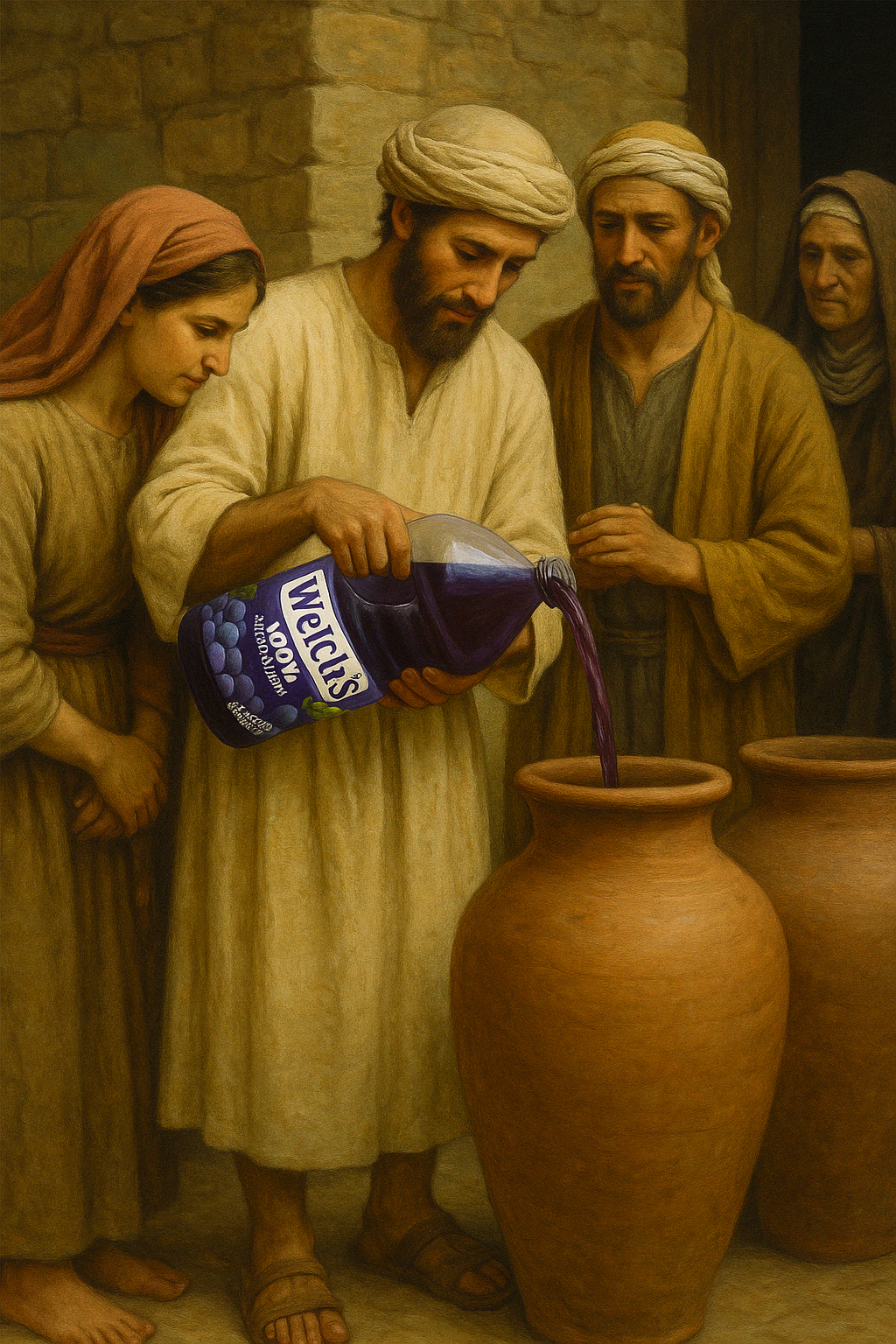
Jesus Didn’t Make Welch’s Grape Juice: When Piety Becomes Legalism
God’s blessings aren’t the problem—your fear of freedom is.
Let’s clear the air right now: Jesus did not turn water into Welch’s. He didn’t perform His first miracle so that Baptists in the 1950s could feel better about banning booze in the church fellowship hall. He turned water into wine—real, fermented, drink-it-and-get-a-buzz-if-you’re-not-careful wine. And not just any wine. The best wine. The kind that made the master of the feast say, “You saved the good stuff for last.” (John 2:10)
Why does this matter? Because somewhere along the line, the church got scared of God’s blessings. We began to think that denying the good things He gave us made us holier. We traded wine for Welch’s, feasting for fasting, joy for solemnity, and freedom for a checklist. We stopped receiving and started retreating.
In our effort to avoid sin, we’ve accidentally crucified the gifts of God on the altar of legalism. But here’s the thing—legalism isn’t holiness. It’s fear dressed in pious robes. It’s control disguised as conviction. And it kills joy faster than a committee meeting.
We confuse restraint with righteousness, and abstinence with spiritual superiority. But Scripture never paints a picture of joyless faith. It paints a garden teeming with beauty. It paints a wedding filled with wine. It paints a table—full of bread, full of wine, full of Christ. The gospel isn’t afraid of your senses. It redeems them.
Somewhere between the Prohibition era and the Pinterest Christian aesthetic, we baptized fear of freedom and called it sanctification. But make no mistake—God isn’t glorified when we reject His blessings out of fear. He’s glorified when we receive them rightly, with gratitude and reverence.
This isn’t a call to hedonism. This is a call to holiness with joy, to freedom without abuse, to gratitude over guilt.
So let’s talk about the good gifts God gave us. Let’s talk about how the church twisted them. Let’s talk about wine, sex, joy, and the God who didn’t just save our souls—He came to give us life, and life more abundantly. (John 10:10)
Because the issue isn’t the wine. It’s the legalism.
And it’s time we put that on the cross where it belongs.
Fermented Faith—The Real Jesus Served Real Wine
Let’s start where Jesus started—at a wedding. Not a seminary. Not a revival tent. Not a 5-step discipleship bootcamp. A wedding. And what did He do? He turned water into wine (John 2:1–11). Not Welch’s. Not Ocean Spray. Actual, fermented, grown-in-the-ground-and-aged-in-a-winepress wine. And He did it as His first public miracle.
Now, some people get real uncomfortable about this. They twist themselves into theological pretzels trying to argue that this was just “grape juice” or “non-intoxicating fruit punch.” Friend, if it didn’t have the power to turn Uncle Larry into a dance floor liability, the master of the feast wouldn’t have cared. But he did. He said, “Most people bring out the good wine first and then bring out the cheap stuff once everyone’s taste buds are dull—but you saved the best for last!” (John 2:10, my paraphrase).
You know what that means? Jesus made the good stuff.
Here’s the punchline: Jesus didn’t make wine in spite of His holiness—He made wine because of it. He came to redeem, not to retreat. He came to bless, not to baptize asceticism. He gave wine as a sign of celebration, community, and joy. It wasn’t about excess—it was about abundance. It was about grace showing up when the cup ran dry.
And yet, some of y’all still flinch at the idea of a bottle of Cabernet sitting on a pastor’s shelf. Why? Because somewhere between Jesus and now, we decided that giving up what God declared good made us spiritual. Spoiler alert: it doesn’t. It just makes us miserable. And possibly a little insufferable.
Let’s do a quick history detour. In the early 20th century, American Protestantism got cozy with the Prohibition movement. The teetotaler crowd grew louder, and suddenly, abstinence wasn’t just a personal choice—it was the only righteous one. Churches started equating alcohol with sin, and before long, grape juice replaced wine at the communion table. Jesus’ words, “This is my blood,” became metaphorically… pasteurized.
And while we’re at it—who decided that real wine in communion was too risky, but fake piety wasn’t? Jesus used wine to symbolize His sacrifice. It was poured. It was bitter. It was red. It had weight. Not watered-down moralism in a plastic cup.
Now, I’m not saying everyone needs to pop open a bottle every night like it’s sacred duty. Some people genuinely should avoid alcohol—due to addiction, conscience, or wisdom. But don’t pretend Jesus shares your fear. He made it. He served it. And He used it as a metaphor for the kingdom of God (Luke 22:18).
The gospel doesn’t fear fermentation. It doesn’t sidestep celebration. And it sure doesn’t turn the water of Christ’s glory into lukewarm grape substitute.
Here’s the bottom line: Wine isn’t worldly. Drunkenness is. Wine isn’t sinful. Self-indulgence is.
Jesus didn’t come to sanctify your self-made rulebook. He came to fulfill the law, pour new wine into new wineskins (Mark 2:22), and remind you that joy isn’t something you should run from—it’s something you should run to.
So next time someone clutches their pearls over the merlot in your fridge, just smile and say, “Jesus made better.”
Blessings Become Curses Through Abuse, Not Use
Here’s a rule of thumb: just because something can be abused doesn’t mean it should be abandoned. If we used that logic consistently, we’d all be wearing burlap sacks in caves, fasting until we keel over from holiness.
Money can be abused—see: every televangelist ever—but we don’t throw away our paychecks. Food can be abused—hello, third trip to Golden Corral—but we don’t starve ourselves to death in protest. Authority can be abused—insert your local HOA horror story—but we don’t dismantle every leadership structure.
But when it comes to alcohol, or sex, or dancing, or feasting, suddenly the reaction is: Ban it. Kill it. Burn it with fire. Hide your kids, hide your wives, the Baptists are dancing!
Friend, abuse does not cancel out design. God’s gifts don’t stop being good just because someone misused them. If anything, their misuse reveals how powerful and purposeful they actually are.
Ecclesiastes 9:7 says, “Go, eat your bread with joy, and drink your wine with a merry heart, for God has already approved what you do.” That’s Bible. That’s Old Testament wisdom soaked in divine approval. Bread. Wine. Joy. Celebration. God isn’t standing over your shoulder with a lightning bolt every time you pop a cork. He’s watching to see if you can enjoy His gifts without making them idols.
Now, let’s not get it twisted. There are real dangers. The Bible doesn’t shy away from warning us about drunkenness (Ephesians 5:18), gluttony (Proverbs 23:2), sexual immorality (1 Corinthians 6:18), and everything in between. But the answer to sin is not fear—it’s faithful stewardship.
Legalism operates on fear. The gospel operates on freedom.
Colossians 2:20–23 is the knockout punch. Paul says, “Why, as if you were still alive in the world, do you submit to regulations—‘Do not handle! Do not taste! Do not touch!’—according to human precepts and teachings?” And then he finishes the thought with a rebuke: “These have indeed an appearance of wisdom in promoting self-made religion and asceticism... but they are of no value in stopping the indulgence of the flesh.”
Translation? Legalism looks holy—but it’s spiritually useless.
You can white-knuckle your way through life avoiding every good gift God gave, thinking your denial earns you extra stars on your heavenly chart. Meanwhile, your heart is full of pride, your soul is dry, and you’ve become a poster child for joyless Christianity.
Jesus didn’t die so you could live like a monk in a monastery avoiding red meat, Riesling, and rhythm.
He died to set you free—from sin, not from the world He made and called “very good.” (Genesis 1:31)
So stop acting like every blessing is a booby trap. They’re not. They’re opportunities—to glorify God through gratitude, to walk in wisdom, to show the world what it looks like when someone enjoys creation without bowing to it.
You want to be holy? Great.
Then don’t just avoid sin. Learn how to handle God’s gifts well.
That’s maturity. That’s freedom. That’s grace.
Sanctified Tastebuds—Alcohol, Enjoyment, and Self-Control
Let’s get something straight: Jesus didn’t come to rob you of flavor. He didn’t go to the cross to save you from full-bodied Bordeaux. He didn’t ascend into heaven so that your only beverage options at church events would be water and unsweetened tea.
Let’s stop pretending God is glorified by grape juice and guilt trips.
In Scripture, alcohol is everywhere. Noah planted a vineyard. Melchizedek brought wine to Abraham. The Psalmist says wine gladdens the heart of man (Psalm 104:15). The Proverbs speak both blessings and warnings regarding wine (Proverbs 3:10; 20:1). The prophets use wine as imagery for judgment and joy alike. And let’s not forget—Jesus served wine at the Last Supper and said, “I will not drink of the fruit of the vine again until I drink it new with you in My Father’s kingdom.” (Matthew 26:29)
If you think heaven won’t have wine, you’re going to be very surprised.
Now, am I saying everyone should drink? No. Am I saying alcohol can’t destroy lives? Also no. What I’m saying is that blanket abstinence isn't the spiritual gold standard we’ve been sold. The fruit of the Spirit isn’t “fear of fermented grapes.” It’s self-control (Galatians 5:23).
Legalism says, “Avoid it all—it’s too dangerous.” Wisdom says, “Use it well—it’s a gift.”
Self-control doesn’t mean abstinence for all time, for all people, forever. It means you have the Spirit-powered maturity to say “no” when it becomes a stumbling block—and “yes” when it can be received with thanksgiving.
But here’s the problem: many churches have adopted a weird, unbiblical stance that it’s somehow more holy to abstain from alcohol altogether—regardless of context, conscience, or culture.
You know what that’s called? Fear-based discipleship.
Instead of equipping believers to walk wisely, we just outlaw the wine altogether. Because that’s easier. No teaching. No discernment. Just black-and-white rules that make everyone feel like they’re being really righteous.
But again—Paul already warned us about that. Remember Colossians 2? Rules made by men. Looks holy. Actually useless.
So what do we do instead?
We preach moderation. We model freedom. We prioritize love.
Romans 14:21 says, “It is good not to eat meat or drink wine or do anything that causes your brother to stumble.” Key word: cause. Not “exist in proximity to someone who doesn’t drink.” Not “drink privately in the dark like a Christian outlaw.” But don’t cause someone to stumble.
This is where freedom meets love. You have liberty—but you also have responsibility. And that’s what real spiritual maturity looks like: joy with guardrails.
So drink the wine. Or don’t. But don’t pretend that your abstinence makes you holier. And don’t judge your brother because his glass has legs.
Because Jesus isn’t measuring your sanctification by the content of your cup. He’s measuring it by the content of your heart.
Sex Isn’t Gross, It’s Glorious—Unless You're Legalistic
Let’s talk about something most churches either whisper about or weaponize: sex.
For centuries, Christian culture has swung between two extremes—treating sex like a dirty little secret or a mechanical act strictly reserved for baby-making and checking off your covenant box.
Spoiler alert: neither is biblical.
Sex isn’t gross. It’s not a necessary evil. It’s not “just for procreation.” And it’s certainly not some low-grade activity that the holier members of the church just “tolerate” in the confines of dimly lit master bedrooms. Sex is glorious. It’s God-designed. It’s for pleasure, intimacy, unity—and yes, sometimes procreation, but that’s not the full story.
You think the Creator of every nerve ending in your body didn’t know exactly what He was doing?
Let’s go ahead and say what purity culture was too uptight to admit: God made sex enjoyable. And He called it good.
Song of Solomon isn’t about having babies. It’s not about scheduling ovulation calendars. It’s Hebrew poetry dripping with marital delight, sensual intimacy, and emotional vulnerability. It’s about desire, not diapers. Passion, not pragmatism.
Let’s not sanitize Scripture just because we’re uncomfortable with what it celebrates.
Proverbs 5:18–19 says, “Let your fountain be blessed, and rejoice in the wife of your youth… let her breasts fill you at all times with delight; be intoxicated always in her love.”
You know what that is? Holy lust. Sanctified obsession. God-glorifying desire between a husband and wife.
But somewhere along the line, the church decided that passion was for pagans and that pleasure was a gateway drug to sin.
Wrong. Sin distorts God’s gifts. It doesn’t own them.
The lie that sex is solely for procreation reduces one of God’s most intimate blessings to a function. That’s like saying food is only for calories or music is only for soundwaves. Technically true. Theologically bankrupt.
God gave us sex as a means of covenant joy—not just reproduction. He built it into marriage as a celebration of unity, trust, and vulnerability. It’s a way to say with your body what your vows declared with your mouth: “I am yours, completely.”
And no, you’re not more spiritual if you endure sex like it’s a trip to the dentist. You’re not more holy because you’re “above those physical things.” That’s not piety—it’s pride dressed in self-denial. And if you want to go full monk, fine—but don’t pretend that makes you more sanctified.
1 Timothy 4:1–5 lays the smackdown on that nonsense:
“Now the Spirit expressly says that in later times some will depart from the faith… forbidding marriage and requiring abstinence from foods that God created to be received with thanksgiving…”
Did you catch that? Forbidding marriage and pushing abstinence as superior holiness is not super-Christian. It’s departing from the faith.
Yikes.
God gave us bodies. He gave us desire. He gave us the covenant of marriage not just as a firewall for lust, but as a playground for joy. Sex in marriage isn’t a last resort to keep men from watching porn. It’s a beautiful act of worship between two image-bearers saying, “God, thank you for this delight.”
So no, sex isn’t just for making babies.
It’s for making oneness. It’s for making joy. It’s for making much of God who made every good thing.
Now let’s stop blushing and start preaching it right.
Dancing, Feasting, and Laughter—Holiness Isn’t a Funeral
If your view of holiness looks like a sad, quiet man sitting alone on a wooden pew with no friends, no laughter, and a permanent case of Resting Pharisee Face—congrats, you’ve confused godliness with gloom.
Somewhere along the line, we decided that joy was suspicious. That if someone was laughing too hard at dinner, they probably needed to repent. That if worship included dancing, it must be emotionalism. That if a pastor made a joke from the pulpit, he clearly wasn’t taking the gospel seriously.
Let me say this plainly: God is not allergic to joy.
In fact, He’s the inventor of it.
Throughout the Bible, God commands celebration. Not suggests. Not permits. Commands.
Deuteronomy 16 outlines multiple feasts for Israel. Entire festivals built around eating, drinking, laughing, dancing, resting, and remembering the goodness of God. Try planning a weeklong church potluck with wine and dancing today and see how many angry emails you get. But God? He baked it into the calendar.
Nehemiah 8:10 says, “The joy of the Lord is your strength.” Not the solemnity. Not the anxiety. Not the obligation. The joy.
Jesus Himself partied. And not just with the clean, neat, already-redeemed crowd. He was known as a friend of sinners (Matthew 11:19). He went to weddings. He accepted dinner invitations. He told stories that made people laugh, squirm, and lean in.
And what was the religious crowd’s reaction?
“He’s a glutton and a drunkard!”
Translation: “He enjoys life too much. Clearly, He’s not holy.”
Sound familiar?
We’ve inherited that same crusty skepticism. We look down on churches that sing too loud, pastors who smile too much, and believers who seem suspiciously happy. Because in our twisted logic, suffering is sacred, and smiling is shallow.
Now, don’t misunderstand me. I’m not saying the Christian life is all sunshine and giggles. There’s suffering. There’s sorrow. There’s weight. But holiness and heaviness aren’t synonyms.
Laughter isn’t the enemy of reverence. It’s often the evidence of grace.
God gave you a face that can smile, a belly that can laugh, and feet that can dance. Why? So you could use them. For His glory.
Psalm 30:11 says, “You have turned for me my mourning into dancing; you have loosed my sackcloth and clothed me with gladness.”
That’s what holiness looks like—it looks like joy restored. Grief turned to gladness. Death to life. Shame to celebration.
But legalism? Legalism sucks the color out of every celebration and calls it sanctification. It turns laughter into guilt and feasting into gluttony by default.
You know what holiness looks like?
- A dad laughing with his kids around a campfire.
- A church singing so loud you can’t hear the instruments.
- A family dancing in the kitchen after a hard week.
- A pastor preaching the gospel with tears in his eyes and a joke in his pocket.
We are not a funeral procession for Jesus. We are a people raised from the dead.
And that means we dance. We feast. We laugh. We rejoice.
Because our King is alive. Because the tomb is empty. Because the table is full.
Holiness isn’t a funeral. It’s a feast.
When Legalism Masquerades as Maturity
Let’s have an honest moment: legalism has a fantastic disguise.
It shows up wearing a well-pressed suit, clutching a King James Bible, with a furrowed brow and an impressive theological vocabulary. It knows all the “right” answers. It never dances. It only listens to piano hymnals. It fasts regularly—loudly. And it absolutely cannot fathom how someone could possibly be saved and sip a glass of cabernet at dinner.
To the casual observer, it looks like maturity.
But look closer. Legalism is spiritual pride wrapped in religious routine. It’s holiness without humility. It’s rules without relationship. It’s fear dressed up like faith.
Jesus dealt with this constantly. The Pharisees had the dress code, the rituals, the Scripture memory, and the social standing. And Jesus called them whitewashed tombs—pretty on the outside, rotting on the inside (Matthew 23:27).
Why? Because legalism doesn’t make you alive. It just makes you look busy.
Legalism says: “Don’t touch, don’t taste, don’t enjoy.”
Grace says: “Walk in the Spirit. Exercise wisdom. Rejoice in the gifts of God.”
But here’s the kicker—legalism is attractive. Why? Because it offers control.
It’s easier to follow a list than to walk in step with the Spirit. It’s more convenient to measure holiness by what you avoid than by how much you love. It’s more comfortable to define your faith by externals than to let the gospel transform your soul.
Legalism lets you feel holy while still being in charge.
That’s the great deception. It’s holiness on your terms. Self-righteousness wrapped in spiritual vocabulary.
And the church has made room for it. We give platforms to people who preach more about rules than redemption. We elevate leaders who are strict but loveless. We call it “sound doctrine,” when it’s really spiritual narcissism hiding behind orthodoxy.
You know who was mature? Jesus. Paul. Peter. The early church. And they were offensive in all the right ways.
Jesus made wine. Paul said, “Everything is lawful—but not everything is helpful.” (1 Corinthians 10:23) Peter learned to eat bacon and hang with Gentiles (Acts 10).
Their maturity wasn’t in what they abstained from. It was in who they were becoming.
Legalism stunts growth because it replaces transformation with behavior modification.
Real maturity? It’s slow. It’s messy. It’s honest. It allows room for conscience. It loves the weaker brother. It celebrates freedom without flaunting it.
But it never—ever—makes the rule more sacred than the Redeemer.
So if your version of Christian maturity looks like a checklist instead of the fruit of the Spirit (Galatians 5:22–23), you might not be holy. You might just be… boring.
God isn’t after robots. He’s after worshipers. People who know how to enjoy His creation without bowing to it. People who can walk in wisdom without hiding behind fences. People who can pour a glass of wine, kiss their spouse, laugh with their kids, and worship with a clean conscience.
That’s not immaturity. That’s grace.
The Gospel Frees You to Enjoy What God Gave
Let’s be blunt: the gospel didn’t show up to lock the liquor cabinet, throw away the chocolate, turn sex into a formality, and make every birthday party feel like a funeral. The gospel isn’t a cage—it’s a key.
The good news of Jesus Christ is not “Try harder. Deny more. Frown longer.” It’s “You are forgiven, set free, and made new. Now live like it—with joy, gratitude, and holy wonder.”
1 Timothy 6:17 says, “God richly provides us with everything to enjoy.” Did you catch that? Not tolerate. Enjoy.
We’ve treated enjoyment like a slippery slope into sin instead of what it actually is—a fruit of freedom. And that’s why so many Christians are exhausted. They’re walking around trying to earn what they already have, avoiding good things they’ve been given, and wondering why their witness feels hollow.
Here’s a radical thought: what if your joy in Christ was part of your testimony?
What if your contentment was louder than your condemnation? What if the way you enjoy a meal, savor your marriage, pour a glass of wine, or laugh with friends at a fire pit made people ask, “What’s different about you?”
Because real freedom isn’t just abstaining from sin—it’s knowing how to walk in wisdom with the gifts God gave you.
1 Corinthians 10:31: “Whether you eat or drink, or whatever you do, do all to the glory of God.” That includes your laughter. Your date nights. Your dance floor moves. Your Sunday afternoon nap. Your hobbies, your holidays, your hot sauce obsession—all of it.
The gospel doesn’t just free you from something. It frees you for something.
Free to worship. Free to enjoy. Free to rest. Free to gather. Free to feast. Free to taste and see that the Lord is good—not just in theory, but in the fullness of His creation.
Yes, we live in a world full of sin. Yes, abuse exists. Yes, idolatry is real. But the answer isn’t rejection—it’s redemption.
Jesus didn’t die to make your life beige. He died to make you new.
So drink the wine—but don’t worship it. Eat the meal—but don’t make it your god. Love your spouse—but don’t idolize them. Laugh loud, dance hard, and live freely—because the King is risen, the tomb is empty, and grace has set the table.
Let the world see that holiness isn’t about the rules you follow, but the Savior you adore.
And if they want to know more, invite them to dinner. Pass the bread. Pour the wine. Tell them about the cross.
And smile while you do it.
Practical Guardrails (Without Building a Cage)
Okay, deep breath. We’ve celebrated the good stuff. We’ve uncaged joy. We’ve called out the sanctified fun-suckers. But now it’s time to talk about something that matters just as much: wisdom.
Because here’s the thing—freedom isn’t a license to be dumb.
You’re not more spiritual for denying what God made. But you’re also not more mature just because you’ve reclaimed wine, Netflix, dance floors, and spicy honeymoon flashbacks. It’s not about flexing your liberty—it’s about stewarding it.
Let me put it plainly: Don’t take the wrecking ball of grace to the fences legalism built, only to go joyriding into a pit of sin. Grace gives you freedom with formation. Joy with judgment. Permission with parameters.
Let’s talk guardrails.
Alcohol? Enjoy it with reverence.
- Don’t drink if you’re prone to drunkenness.
- Don’t drink around someone who’s struggling.
- Don’t drink as an escape from your problems.
- Do drink to celebrate God’s goodness with a clear conscience, a full heart, and a responsible pour.
Sex? Celebrate it covenantally.
- Don’t bring in the world’s garbage.
- Don’t use it selfishly.
- Don’t weaponize it.
- Do enjoy it regularly, joyfully, and gratefully within marriage.
Food? Feast with self-control.
- Don’t turn your table into a god.
- Don’t binge your emotions into silence.
- Don’t confuse abundance with gluttony.
- Do gather around meals, celebrate flavors, and say “thank you” to the Giver of every spice, roast, and ribeye.
Entertainment? Watch with discernment.
- Don’t baptize filth in the name of “freedom.”
- Don’t fill your soul with what Christ died to deliver you from.
- Don’t mock sin and call it maturity.
- Do enjoy stories, music, and media that stir affection for the beautiful, the true, and the good.
The line between liberty and licentiousness is real. And if you can’t tell the difference, then maybe freedom isn’t the issue—maybe it’s idolatry.
God’s not impressed with your “I can do whatever I want” attitude. He’s glorified when you say, “I could… but because I love Him, I won’t.” Or better yet, “I could… and because I love Him, I will—with joy, gratitude, and restraint.”
Don’t flaunt your freedom. Steward it. Don’t provoke the legalist. Love them. Don’t scandalize the weak. Carry them. Don’t stumble into bondage. Walk in the Spirit.
Romans 14 and 1 Corinthians 8–10 weren’t written so we could bash each other with wine bottles and essential oil diffusers. They were written to show us what it looks like when freedom bows to love.
If your liberty makes your brother fall, it’s not liberty—it’s selfishness.
If your “freedom” enslaves you again to sin, it’s not grace—it’s arrogance.
And if your joy causes others to worship your lifestyle more than your Lord, it’s not holiness—it’s just a different idol.
Grace builds guardrails, not cages. It lets you drive the scenic route without flying off the cliff.
So enjoy. But with humility. Celebrate. But with self-awareness. Laugh. But not at someone else’s weakness. Drink. But don’t drown.
Freedom isn’t the absence of boundaries. It’s the presence of wisdom.
Let me know when you're ready to bring it all home with Section IX: “Conclusion: Jesus Didn’t Make Welch’s, and You Don’t Have to Either.”
Jesus Didn’t Make Welch’s, and You Don’t Have to Either
Let’s land this plane.
Jesus didn’t turn water into Welch’s. He didn’t hand out sparkling grape juice at weddings. He didn’t come to earth, live a perfect life, suffer, die, rise again, and ascend to heaven just so you could live a beige, boring, spiritually neutered life filled with guilt over every good thing He gave you.
He came to redeem you—and with you, your ability to enjoy God’s creation rightly.
The gospel is not “Don’t touch, don’t taste, don’t enjoy.” It’s “Taste and see that the Lord is good.”
He is the God of vineyards and bread ovens. He is the God of fireplaces and feasting tables. He is the God of marriage beds and warm laughter and real joy that echoes through eternity.
Legalism will tell you that if it feels good, it’s probably sinful. The gospel says if it’s done in reverence, with gratitude, inside God’s design—it’s worship.
You weren’t saved to live scared. You weren’t redeemed to live rigid. You were bought with a price to walk in the Spirit, filled with joy, armed with discernment, and unafraid of the table God set before you.
Jesus is not ashamed of the good gifts He gave. So stop acting like He is.
If you’re abstaining from things because of wisdom, conscience, or care for others—praise God. That’s maturity. But if you’re abstaining because you think God will love you more for living like a 16th century monk—repent. That’s pride.
The finished work of Christ is enough. You don’t need to add asceticism to your salvation. You don’t need to prove your holiness through a checklist. You need to enjoy your Redeemer—and let His goodness overflow into every part of your life.
So no, Jesus didn’t make Welch’s. And you don’t have to either.
Uncork the wine. Turn up the music. Dance with your spouse. Laugh with your kids. Feast with your church. And give thanks to the God who made all of it and said—it is very good.
This is what grace tastes like.
And if that offends someone? Just tell them Jesus made better.
Thanks for reading.


