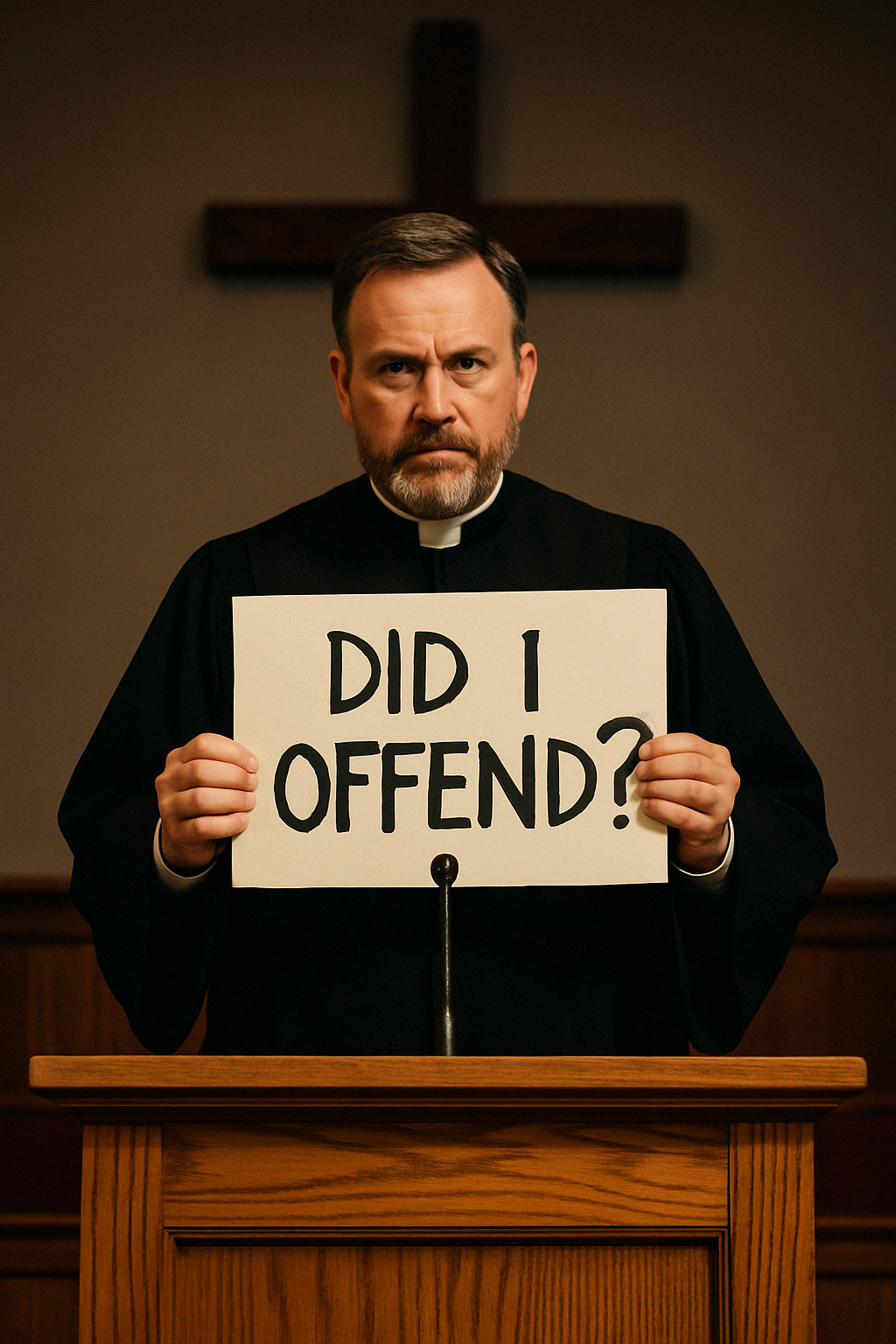
If Your Pastor Never Offends You, He’s Probably Not Preaching the Gospel
Truth doesn’t tickle ears—and neither should your Sunday sermon.
Let’s make something perfectly clear: I didn’t enter ministry to make people feel better about themselves. I entered ministry because I was compelled by Christ, gripped by the truth, and terrified at the weight of “those who teach will be judged with greater strictness” (James 3:1). So if you came here expecting a pastor to pat your sin on the head, hand you a venti grace latte, and tell you “You’re enough”—this ain’t that kind of pulpit.
I preach the whole counsel of God. The parts that make you cry tears of joy, the parts that make you squirm in your seat, and the parts that make you question if you’ve actually been saved at all. Not because I’m angry—but because I’m faithful. Because Scripture commands it. Because Christ deserves it. And because the people of God need it.
The truth is, if your pastor never offends you—never says something that cuts, confronts, and calls you out—he’s either:
- Not reading his Bible carefully,
- Doesn’t know his congregation well, or
- Too afraid to preach what God actually says.
None of those are acceptable.
The gospel is good news—but it starts with an offense. It doesn’t say “you’re doing fine, just try harder.” It says, “You are dead. You are guilty. You need a Savior—and His name isn’t you.”
And in a world drunk on affirmation and allergic to truth, that message will not go over well. But that’s precisely the point. The Word of God isn’t meant to go down smooth. It’s a sword. It cuts. It divides. It exposes. And it heals. But healing never happens until infection is confronted.
So buckle up. This isn’t a self-help sermon. This is war. War against lies. War against compromise. War against the kind of soft, neutered Christianity that packs pews but never makes disciples.
We’re going deep into what faithful preaching looks like. Why it must offend before it comforts. How Christ Himself offended His audiences regularly. Why preaching isn’t therapy, it’s confrontation. And how modern churches have traded conviction for clicks.
This isn’t about being harsh—it’s about being holy.
Because the only preaching worth hearing is the kind that kneels before Christ and dares to say, “Thus saith the Lord.”
Let me know when you're ready for Section I: The Gospel Offends—And That’s the Point.
The Gospel Offends—And That’s the Point
Let’s clear the air right out of the gate: the gospel is not a message of self-help, self-esteem, or self-actualization. It is a message of death, burial, and resurrection. It says that the old self isn’t meant to be celebrated—it’s meant to be crucified.
Paul didn’t stroll into Athens with a TED Talk. He came with trembling and fire and truth. And what was the result? Mockery, division, riots, and conversions. Because when you preach the real gospel, those are your options.
1 Corinthians 1:18 says, “For the word of the cross is foolishness to those who are perishing, but to us who are being saved it is the power of God.” Foolishness. Offensive. Nonsensical. That’s how the world hears the truth—until the Spirit opens their eyes. And we, as preachers, do not have the luxury of softening that edge.
We preach a gospel that begins with “You are dead in your sins” (Eph. 2:1), not “You are a good person with a few flaws.” We preach a Christ who didn’t come to improve lives but to resurrect the spiritually dead. That kind of message will always offend.
In fact, if your gospel never offends anyone, it’s probably not the biblical one. It might be moralism. It might be positive thinking. It might be Christian-flavored therapy. But it’s not the gospel of Jesus Christ.
The offense of the gospel isn’t a bug—it’s a feature.
It offends our pride, because it says we can’t save ourselves. It offends our morality, because it says even our best works are filthy rags. It offends our autonomy, because it demands we bow to Christ as King.
And that’s why real preaching doesn’t aim for applause—it aims for allegiance. Allegiance to Christ, not comfort. Allegiance to truth, not feelings. Allegiance to Scripture, not trends.
Jesus Himself said in Matthew 10:34, “Do not think that I have come to bring peace to the earth. I have not come to bring peace, but a sword.” That doesn’t sound like the soft-spoken, non-confrontational Jesus that modern culture likes to project, does it?
Christ’s truth divides. It creates tension. It causes conflict—not because it's unloving, but because it’s uncompromising. Because it exposes sin, idols, and false gods. And that process, while painful, is the only path to real peace—the kind that starts with repentance and ends with reconciliation.
So if you’re offended by the gospel, you’re in good company. That means it’s doing its job.
Jesus Preached Offensively—Why Can’t We?
Let’s take off the felt-board filter and look at the real Jesus. Not the “nice guy with great hair who hugged kids and dropped vague truths about love.” I’m talking about the Jesus who flipped tables, rebuked religious leaders to their faces, called people children of Satan (John 8:44), and preached such hard truths that everyone but the disciples left (John 6:66).
Yeah. That Jesus.
Jesus never aimed to be liked. He aimed to reveal the truth. He was grace and truth incarnate, not a therapist with a messiah complex.
In Luke 4, Jesus stands up in His hometown synagogue and reads from Isaiah. The crowd loves it—until He tells them God’s blessings weren’t just for them. Then what do they do? They try to throw Him off a cliff. Off. A. Cliff.
In John 6, He feeds thousands, they try to make Him king, and then He preaches the hard stuff: “Eat my flesh, drink my blood.” The crowd dips. They bail. Why? Because the moment the message stopped being comfortable, they were out.
But Jesus didn’t chase after them. He didn’t soften the message. He turned to His disciples and said, “Do you want to go away as well?” (John 6:67). That’s not a seeker-sensitive model. That’s the Son of God preaching for faithfulness, not for fans.
So why are so many pastors today afraid to preach like Jesus?
We want the results of Christ’s ministry without the cost. We want the fruit of revival without the fire of truth. We want the crowds, but not the cross.
And let’s be honest: we’re addicted to approval. Sermons have become TED Talks with a splash of Scripture. Preaching has been demoted to performance. Truth has become a suggestion. And the only sin left in the pulpit is the sin of making people feel bad.
But Jesus made people feel worse before they felt the joy of salvation. He revealed the depths of their depravity so they could behold the heights of His grace.
Offensive preaching isn’t optional—it’s Christlike.
And if Jesus didn’t shy away from confrontation, why should we?
The Purpose of Preaching Isn’t Comfort—It’s Confrontation
If your Sunday sermon feels like a cozy motivational talk with a sprinkle of Jesus on top—congrats, you just got a theological cupcake. Sweet, soft, and totally lacking substance.
But real preaching? It isn’t supposed to tuck you in and read you spiritual poetry. It’s supposed to grab you by the soul, drag you into the light, and force you to deal with the fact that you’ve been trying to sit on the throne of your life while pretending Jesus is your co-pilot.
The pulpit isn’t a platform for personality. It’s a battlefield. And the man behind it isn’t there to comfort your carnality—he’s there to confront it.
Paul didn’t tell Timothy, “Preach what makes people feel affirmed.” He said: “Preach the Word; be ready in season and out of season; reprove, rebuke, and exhort, with complete patience and teaching.” (2 Timothy 4:2)
Did you catch that? Reprove. Rebuke. Exhort.
That’s not exactly a spa day for your soul.
But that’s the job. The preacher’s task is to call people into a war they didn’t even know they were in. And that means swinging the sword of the Spirit with precision, not tossing out inspirational fluff like a party clown handing out balloons.
You don’t need a preacher who hugs your idols. You need one who throws them to the ground and smashes them in front of you.
Here’s what we’ve lost: the sheer gravity of the pulpit. Somewhere between the fog machines, clever sermon series, and TikTok clips, we forgot that preaching is sacred. It’s the moment where eternity collides with earth. Where sin is named. Where Christ is exalted. Where men tremble. And where saints are made strong.
Comfort preaching doesn’t make disciples. It makes fans.
And fans walk away when the message gets too hard.
Just ask Jesus.
The world is full of broken people looking for peace. But what they need isn’t temporary relief—they need resurrection. And resurrection only comes after death. The death of pride. The death of self-reliance. The death of pretending everything is fine.
So no, preaching isn’t here to make you feel better. It’s here to make you new.
The Apostle Paul Didn’t Pull Punches—Neither Should We
If Paul showed up to most churches today, he’d get pulled into a backroom meeting with the elders before the second verse of the opening worship song.
“Hey brother, we love your heart, but you came across a little too strong during your sermon. Maybe you could tone down the talk about sin, wrath, and judgment next time? The families in the back weren’t sure how to explain ‘fleshly lusts warring against the soul’ to their toddlers.”
Right. Because Scripture is for grown-ups only now?
Let’s not forget this is the same Paul who called out the Corinthian church for tolerating sexual immorality so vile that not even pagans practiced it (1 Corinthians 5). He told the Galatians that if anyone preached a different gospel—even if it was an angel from heaven—they should be accursed (Galatians 1:8).
He told the Judaizers to go the whole way and emasculate themselves (Galatians 5:12). That’s not exactly “winsome,” is it?
Paul didn’t write polite letters filled with vague encouragement and Pinterest quotes. He wrote blistering, bold, blood-earnest proclamations of truth that made the spiritually lazy squirm and the truly saved shout “Amen.”
And don’t forget Acts 20:26–27. Paul says, “I am innocent of the blood of all, for I did not shrink from declaring to you the whole counsel of God.” Let that sink in.
He didn’t just say the comforting parts. He didn’t stick to the Psalms and skip over the prophets. He didn’t cherry-pick the affirming texts and ditch the warnings. He gave the whole counsel—which means people probably left offended, convicted, and occasionally furious.
But Paul wasn’t in it for applause. He was in it for faithfulness.
He viewed his role not as a public speaker, but as a watchman. And if the watchman sees the sword coming and doesn’t blow the trumpet? The blood is on his hands (Ezekiel 33:6).
Too many modern pastors are blowing bubbles instead of trumpets. They’re so afraid of being labeled judgmental or losing their audience that they preach ten miles wide and one inch deep—safe sermons, soft conclusions, and no call to repentance.
That’s not loving. That’s cowardice dressed up as compassion.
Paul didn’t ask if his message would go viral—he asked if it was true. He wasn’t concerned about comfort—he was consumed with truth.
If you want to preach like Paul, be prepared to get the same response: prison, pushback, and possibly an empty building. But what you will have? A clear conscience before God, a reputation for integrity, and maybe—just maybe—a church that actually fears the Lord instead of craving the culture’s approval.
So to every preacher reading this: preach the gospel with fire. Preach it when they cheer. Preach it when they glare. Preach it when they walk out.
Because one day you’ll stand before God—not your audience.
Offense Is Not Abuse—It’s Often Grace in Disguise
Let’s get this straight: not every offense is abuse. Not every confrontation is trauma. Not every firm word is spiritual violence. Sometimes—brace yourself—it’s just the truth doing what the truth does: cutting through your nonsense.
We live in a culture that treats feelings as the final authority. If you feel hurt, then someone must have sinned. If you feel offended, someone must apologize. If you feel uncomfortable, something must be wrong. And sadly, this emotional fragility has infiltrated the church.
Let’s be honest—this generation has the emotional pain tolerance of a sunburned toddler. We’ve replaced repentance with “boundaries,” boldness with “toxicity,” and any call to holiness gets dismissed as “religious trauma.”
But the Bible doesn’t play those games.
Hebrews 4:12 says, “For the word of God is living and active, sharper than any two-edged sword… discerning the thoughts and intentions of the heart.” That’s not a feather duster. That’s a scalpel. It cuts, it convicts, it stings—and that’s grace.
Jesus didn’t come to soothe your feelings. He came to save your soul. And if your soul is enslaved to sin, guess what? That rescue mission is going to hurt before it heals.
The gospel isn’t spiritual aromatherapy. It’s CPR. It’s shocking a dead heart back to life. And if you walk out of every sermon feeling warm, cozy, and entirely unbothered—friend, you didn’t get a sermon. You got a pep talk with Bible verses.
Jesus constantly offended people. And not by accident.
- He told the rich young ruler to give up everything. (Mark 10:21)
- He called Peter Satan to his face. (Matthew 16:23)
- He told entire crowds, “You’re only here for the bread.” (John 6:26)
- He told religious elites they were whitewashed tombs—beautiful on the outside, rotting on the inside. (Matthew 23:27)
But here’s the kicker: He was right.
Their feelings didn’t validate their rebellion. Their offense didn’t override His truth. And today? The exact same applies.
In fact, Proverbs 27:6 says, “Faithful are the wounds of a friend; profuse are the kisses of an enemy.” Translation? Real love stings sometimes. Fake love just flatters you while you’re walking off a cliff.
This “if it hurts, it’s wrong” nonsense is killing the church. We’ve got people leaving solid, biblical churches because they “didn’t feel safe.” Not because they were abused. Not because they were mistreated. But because the preacher had the audacity to open the Bible and preach what it actually says about sin, hell, judgment, and repentance.
If you’re offended by the gospel, that doesn’t mean you’re a victim. It might just mean you’re a sinner under conviction.
And that? That’s grace.
Because when God offends you, He’s not hurting you—He’s rescuing you. He’s breaking your pride so He can bind up your wounds. He’s shattering your idols so He can show you His face.
So stop calling conviction “abuse.” Stop labeling truth as “spiritual trauma.” Stop equating biblical confrontation with being “unsafe.”
Unsafe? You think Jesus was “safe” when He told Nicodemus, a respected religious leader, “You must be born again”(John 3:3)? You think Paul was “safe” when he told the Corinthians they were arrogant, divided, and immoral? You think the cross is “safe”? It’s bloody. It’s offensive. And it’s the only hope we have.
Offense is not abuse—it’s a mercy.
It’s God pulling the blinders off your eyes. It’s the Spirit setting fire to your self-deception. It’s the Word doing what it was meant to do—sanctify you.
So stop running every time your toes get stepped on. Maybe it’s not spiritual abuse. Maybe it’s spiritual surgery.
And if your church refuses to offend you, they’ve probably decided it’s easier to let you die comfortably than to save you painfully.
A Gospel That Doesn’t Confront Sin Isn’t the Gospel at All
Let’s not play games—if your version of the gospel doesn’t have a problem with your sin, it’s not the gospel. It’s a Disneyfied delusion with a cross-shaped logo slapped on the front.
The gospel doesn’t politely nod at your rebellion. It doesn’t sidestep your pride. It doesn’t accommodate your addiction, coddle your compromise, or excuse your lust. The gospel kicks down the doors of your delusion, throws your sin into the light, and demands that you choose: Christ or self.
No middle ground. No soft landings.
And yet, how many churches have gutted the gospel of its teeth? We’ve removed the call to repentance and replaced it with the invitation to “begin your faith journey.” What does that even mean? Faith isn’t a hike through the hills—it’s a bloody, soul-wrecking confrontation with the holiness of God and the horror of your sin.
Romans 3:23—“For all have sinned and fall short of the glory of God.” There it is. Everyone. All of us. Your grandma. Your favorite influencer. You.
Romans 6:23—“For the wages of sin is death…” That’s not a metaphor. That’s judgment. That’s hell. That’s eternal separation from the God you’ve spent your whole life ignoring.
But thank God it doesn’t stop there.
“…but the free gift of God is eternal life in Christ Jesus our Lord.”
That’s the gospel. Not “God loves you just the way you are.” But “God loves you too much to leave you the way you are.”
And yet what do we hear from the modern pulpit? “Come to Jesus and He’ll give you peace, joy, purpose, better sleep, and a vision board.”
No! Come to Jesus because you’re under the wrath of God and you need a Savior.
You want peace? Then you need reconciliation. You want joy? Then you need forgiveness. You want purpose? Then you need to die to yourself and be raised with Christ.
You can’t skip repentance and get to redemption. You can’t dodge sin and still find salvation.
That’s why the gospel confronts sin head-on. It doesn’t whisper. It roars.
Jesus didn’t come to make bad people better. He came to make dead people alive.
And that resurrection starts with a funeral—the death of your pride, the burial of your ego, the end of your self-worship.
But if your gospel preaches life without death, grace without repentance, love without truth—it’s not the gospel.
It’s a lie. A soul-damning, cross-emptying, hell-ignoring lie.
Preachers, hear me: If you love your people, you will preach their sin. Not to shame them. But to save them.
Because sin isn’t just “brokenness.” It’s rebellion. And rebellion needs a Redeemer, not a rebranding.
Acts 3:19 says, “Repent therefore, and turn back, that your sins may be blotted out…” You want to be clean? You want a fresh start? You want grace? It begins with repentance.
So enough with the sanitized sermons. Enough with the glitter-coated gospel. Enough with the Christianese fluff.
The gospel is blood and glory. Wrath and mercy. Justice and grace. Sin and a Savior.
And if you’re preaching one without the other, you’re not preaching the gospel—you’re preaching a counterfeit.
Soft Sermons Produce Shallow Saints
Let’s go ahead and say it: the reason so many churches are full of biblically illiterate, emotionally fragile, and spiritually lukewarm people is because their pastors preach like spiritual life coaches instead of blood-bought heralds of truth.
Soft sermons produce shallow saints.
They create people who can quote Instagram devotionals but can’t find Habakkuk in their Bible. People who know how to “speak life” but have never been told to repent.
You want to know why so many Christians fold like a cheap lawn chair when pressure hits? Because they’ve been fed cotton candy theology their whole lives. It tastes good going down, but it leaves you malnourished—and eventually, sick.
If your preacher spends more time smiling than sweating in the pulpit, we’ve got a problem.
If you walk out of church every week feeling amazing but never convicted—run.
Enter Joel Osteen—the poster boy of spiritual fluff. The guy could read Leviticus and somehow turn it into a motivational speech about stepping into your “destiny.” He grins through his sermons like he’s hosting a game show, and never—never—mentions sin, judgment, or repentance unless it’s tucked behind a warm fuzzy platitude.
“God wants to bless you!” Sure. But He also wants to break you, sanctify you, and conform you to Christ—and spoiler alert: that process is not glamorous. It’s painful. It’s bloody. And it’s beautiful.
And Joyce Meyer? She’ll give you some great tips on positive thinking, financial success, and how to “command your morning.” But when it comes to the weighty, soul-rattling doctrines of sin, grace, wrath, holiness, and the sovereignty of God—crickets.
The gospel has been neutered, sanded down, and smoothed over to fit neatly in a 28-minute TV segment sponsored by your local Christian bookstore and five-dollar seed offerings.
Meanwhile, men like Voddie Baucham are thundering from the pulpit that the church is asleep in the light. Paul Washer is bringing entire youth groups to their knees with the shocking truth that not everyone who says “Lord, Lord” will enter the kingdom of heaven.
And R.C. Sproul—oh, how we miss him—once looked a crowd of churchgoers in the eye and responded to the question, “Why was God so severe with Adam?” with a roar of: “WHAT’S WRONG WITH YOU PEOPLE?”
That’s what we need. Not entertainers. Not influencers. But prophets. Watchmen. Shepherds who understand that they are accountable before God Himself for every word they preach (James 3:1).
We need preaching that terrifies sin and magnifies Christ. We need pulpits that are stained with prayer and soaked in the Word. We need sermons that make the comfortable squirm and the broken rejoice.
Soft sermons may fill pews. But they empty altars.
They won’t call you to die to yourself. They won’t prepare you for persecution. They won’t hold you accountable when you drift. They’ll just pat you on the head, hand you a five-point plan to “live your best life now,” and smile while you wander straight into judgment.
Enough.
Preach the Word. Preach it with fire. Preach it with fear and trembling. Preach it like you’ll answer to God—because you will.
When Pastors Fear Man, the Church Forgets God
Let’s call it what it is—the fear of man is pastoral poison. It silences the truth, inflates egos, and puts the church on a collision course with apostasy. When pastors are more afraid of tweets than of judgment day, more afraid of offending a tither than grieving the Holy Spirit, you don’t get revival—you get rot.
Proverbs 29:25 says it plainly: “The fear of man lays a snare, but whoever trusts in the Lord is safe.” And let’s be honest, many pulpits today are full of preachers who have walked straight into that snare and made it a hammock.
Why? Because we’ve created an entire culture where offending man is the ultimate sin—and offending God is just something we apologize for later “if we have time in the closing prayer.”
The moment a pastor starts calibrating his sermons to maintain the approval of people instead of the pleasure of God, he has abandoned his post as a shepherd and assumed the role of a mascot. And mascots don’t fight wolves—they dance for crowds.
The church is being led by cowards in clerical collars and influencers in skinny jeans who would rather be liked than **holy.**They edit the Word of God like PR reps managing a scandal, cutting out anything that might upset the congregation, donors, or Instagram algorithms.
Here’s the wake-up call: you cannot lead sheep while you fear goats.
If you won’t preach about hell because it might scare people—then you’ve forgotten that Christ talked about it more than anyone else. If you won’t address sexual immorality because it might get you labeled “hateful”—then you’ve forgotten that Paul told the Corinthians to purge the evil person from among you. If you won’t speak about sin because you want your church to “be a safe space”—then congratulations, you’ve created a sanctuary that’s safe for sinners and hostile to saints.
Let me say it plain: fear of man makes preachers dumb and churches dull.
Dumb, because they stop rightly dividing the Word. Dull, because they have no edge to pierce the heart.
We don’t need safe sermons. We need sharp ones.
Elijah didn’t fear Ahab. Jeremiah didn’t fear priests and kings. John the Baptist called out Herod’s adultery and lost his head for it. And Jesus—Jesus flipped tables and pronounced woes over entire religious systems while the crowds gasped.
But today? We’re scared of a nasty comment on Facebook.
If your pulpit sounds more like a PR campaign than a prophetic voice, it’s time to repent.
Galatians 1:10 wasn’t written for the apostle Paul’s journal—it was written for every pastor who has ever been tempted to bend under the weight of public opinion: “If I were still trying to please man, I would not be a servant of Christ.”
You can’t serve two masters.
You either fear God, or you fear the people He called you to serve. You either preach to glorify Him, or you preach to be admired. You either tremble before the throne of heaven—or you tremble before a church committee.
But know this: if you fear man, your church will forget God.
They will forget what it means to stand in awe of His holiness. They will forget what it means to tremble at His Word. They will forget what it means to repent, to obey, to worship—not because they weren’t told, but because their shepherd was too scared to say it.
Offend Them Toward the Cross
Here we are—the final nail in the polite, crowd-pleasing coffin.
Let’s get one thing straight: the goal of faithful preaching isn’t to offend for the sake of being edgy. It’s not about being abrasive. It’s not about yelling louder or making people uncomfortable just to prove a point.
The goal is this: offend them toward the cross.
Because the cross is offensive. It always has been. Always will be.
1 Corinthians 1:23—“But we preach Christ crucified, a stumbling block to Jews and folly to Gentiles.”
That’s what the cross does. It confronts. It accuses. It condemns our sin, destroys our self-righteousness, and declares that we can’t save ourselves.
You don’t stroll casually toward Calvary. You stumble there, bruised by the truth, crushed by your guilt, and desperate for a Savior.
And here’s the glorious scandal: when you finally arrive, bloodied in soul and bankrupt in spirit—He’s there.
Not to scold, but to save. Not to affirm your brokenness, but to forgive your sin. Not to give you a better life—but to give you eternal life.
That’s why we preach the hard stuff. That’s why we say what makes people uncomfortable. That’s why we stand in pulpits and say, “Repent and believe,” even if they walk out.
Because if the truth offends them all the way to the foot of the cross—praise God.
Offend the prideful, so they learn humility. Offend the self-sufficient, so they fall into grace. Offend the cultural Christian, so they meet the real Christ.
If no one is ever offended by your gospel, then your gospel is too weak to save.
And to the preacher who’s afraid—hear me: You are not called to be liked. You are not called to build a platform. You are called to preach Christ crucified.
So preach Him.
Loudly. Boldly. Unapologetically.
Preach the whole counsel. Preach the ugly and the beautiful. Preach sin and salvation. Preach wrath and grace. Preach justice and mercy. Preach until your people see the weight of their guilt and the wonder of the Lamb who was slain.
Because if you offend them into repentance, you’ve done your job. If you offend them into eternity, you’ve preached well. If you offend them toward the cross—you’ve loved them better than any motivational message ever could.
So go ahead. Offend them.
And then show them Jesus.
Thanks for reading.


